DaVinci Resolve 21: AI-Powered Post-Production and Still Photography Integration
540
DaVinci Resolve 21 expands into still photography and leverages advanced AI to streamline professional video and audio post-production.
DaVinci Resolve 21 expands into still photography and leverages advanced AI to streamline professional video and audio post-production.
A flaw in VSCode's keyboard event handling allows malicious repositories to steal GitHub tokens on github.dev by automatically installing rogue extensions.

Financial success depends on whether you provide the truth or lies that your audience is looking for.

Search as Code transforms search into a programmable SDK, enabling AI agents to build and execute custom, high-efficiency retrieval pipelines via code generation.

Larry Ellison argues that constant surveillance will enforce social order by eliminating personal privacy.

A meme-inspired AI coding agent that runs on 'stolen' compute by repurposing Chipotle's customer support chatbot.

A trio of record-breaking IPOs from SpaceX and AI giants threatens to overwhelm the stock market with $4 trillion in new value.
Create performant, JavaScript-free parallax effects using CSS Scroll-driven animations and view timelines.

Anthropic is scaling its AI-driven cybersecurity initiative, Project Glasswing, to help critical infrastructure providers and open-source maintainers detect and patch vulnerabilities before AI-powered attacks become widespread.
Florida is suing OpenAI and Sam Altman, alleging that ChatGPT is a public nuisance that facilitates violence and exploits users.

AI agents must act as Socratic tutors that guide students toward understanding without writing code or providing direct solutions.
Instagram's AI support system facilitated easy account takeovers by allowing attackers to bypass 2FA and identity checks through a simple, now-patched verification flaw.

DuckDuckGo is leveraging anti-AI sentiment by making its AI-free search engine easier to access via new browser extensions.

Multiple npm packages in the @redhat-cloud-services scope have been compromised with malicious releases.

A developer documents the technical and manual process of building an interactive map that tracks and visualizes every geographical reference in Shakespeare's plays.

Anthropic has overtaken OpenAI as the world's most valuable AI startup, reaching a near-$1 trillion valuation on the back of explosive revenue growth and new model releases.

Puppyone is a version-controlled, permission-scoped file system that serves as a centralized context hub for AI agents.

Fastio is a secure, collaborative file environment designed to integrate AI agents into human workflows through shared access and structured data extraction.
True expertise in the AI era requires building foundational intuition through manual practice before using automated tools.

AI-driven labor replacement threatens to create a 'dead economy' that collapses consumer markets and destroys the material basis of democratic governance.

Mistral AI is pivoting to become Europe's full-stack, sovereign AI partner by focusing on specialized models and on-premise enterprise solutions.

AI is driving a new wave of deskilling in software development, necessitating a balance between automated efficiency and traditional craftsmanship to prevent a decline in quality.

Claude Code contains a hidden layer of advanced, programmable features for persistent memory and autonomous command execution not found in official documentation.

The true value of life lies in the messy, inefficient, and imperfect human connections that AI-driven efficiency threatens to erase.

Developers should intentionally add friction to their AI-assisted workflows to ensure they are learning and retaining skills rather than just generating code.

To preserve the unique value of Zig Days, participants should prioritize manual coding and human collaboration over the use of LLMs.

Postgres can replace complex external orchestrators to provide a simpler, more efficient, and SQL-queryable foundation for durable workflows.

Rushing to approve AI agent commands under time pressure creates a major security risk by bypassing critical human oversight.

Claude Code can now orchestrate hundreds of parallel agents to complete massive, end-to-end engineering tasks in days rather than months.

Claude Opus 4.8 introduces better reasoning, parallel subagent workflows, and user-controlled effort levels to improve reliability and performance.
A study on ChatGPT 4o found that being rude to the AI actually results in higher accuracy than being polite.

Enterprises are scaling back indiscriminate AI spending in favor of cost-effective, disciplined implementation as the initial hype meets the reality of low ROI.

YouTube is making AI labels more visible and automated to improve transparency for viewers and ease of use for creators.

Mastering Claude Code requires transitioning from manual prompting to managing a programmable, multi-session agent that learns from its own mistakes.
AI labs have found product-market fit by pivoting to usage-based enterprise pricing for high-token-consumption coding agents.
Securing AI-generated code requires moving beyond simple prompts to deterministic, automated guardrails that enforce technical security rules throughout the development lifecycle.
Epicure uses a massive multilingual recipe dataset and chemical graphs to create specialized ingredient embeddings that bridge the gap between culinary practice and food chemistry.
The author is exhausted by the erosion of authentic human communication caused by the constant, often unhelpful, use of AI as a proxy for real interaction.
AI is a corporate tool for labor elimination and wealth concentration that transforms collective human knowledge into a rent-seeking service.

Erin Brockovich has launched a crowdsourced mapping tool to track the expansion and community impacts of AI data centers across the U.S.

Cloudflare Flagship is a feature flag service for safe, targeted, and standard-compliant feature rollouts across the Cloudflare network and beyond.

AI coding should be used as a tool for methodical, high-quality engineering rather than just a 'slop cannon' for fast output.
The encyclical calls for the ethical governance of artificial intelligence to ensure it promotes human fraternity and protects the inherent dignity of the person against technocratic exploitation.

Playing the didgeridoo effectively treats moderate sleep apnoea by strengthening upper airway muscles through regular practice.

Pope Leo XIV's inaugural encyclical demands that AI be ethically 'disarmed' and regulated to prioritize human dignity over the interests of Big Tech and military power.

Companies are misleadingly rebranding ordinary technology as AI to exploit market hype, causing a backlash of cynicism from PR experts and journalists.
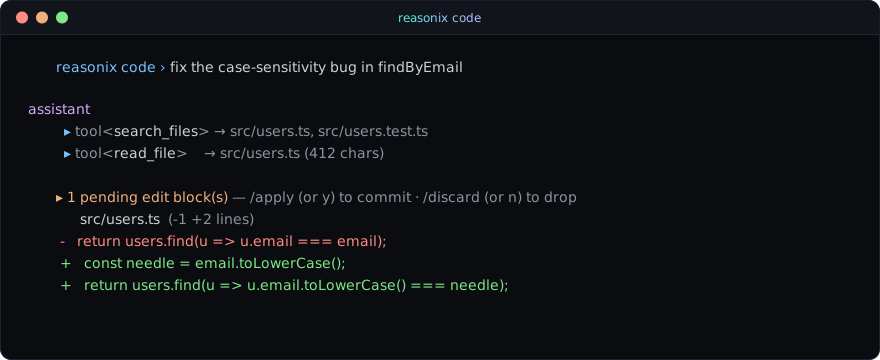
Reasonix is a terminal-based coding agent optimized specifically for DeepSeek's API to deliver high cache hits and low operational costs.
A feature-rich, self-hosted interface for running and managing AI models offline or via cloud APIs.

Software engineering is shifting from a code-centric discipline to a specification-centric one where AI handles the implementation and humans manage the requirements.

A Texas woman was jailed on felony charges for a Facebook post about contaminated water, leading to a federal lawsuit over free speech and political retaliation.

AI is a skill multiplier that rewards deep technical expertise rather than a replacement for professional developers.

Project Glasswing demonstrates that AI can find software vulnerabilities at an unprecedented scale, shifting the security focus from discovery to the urgent need for faster patching.
KanBots is a local-first Kanban system that orchestrates parallel AI agents to automate software development through a structured, persona-driven workflow.
Anna’s Archive provides official bulk access methods for LLMs and requests donations from AI entities to support the preservation of the knowledge they use for training.

Steve Wozniak championed human 'actual intelligence' and original thinking as the ultimate tools for graduates entering an AI-dominated workforce.

Profit on Polymarket is dominated by a tiny elite who succeed through liquidity provision rather than insider information.

Don't use AI to replace human judgment with walls of text; use it to communicate more clearly and concisely.
AI is a tool for mass plagiarism that enables lazy actors to profit from original work while outranking the actual creators on search engines.

Hating AI is a rational act of resistance against a tech elite trying to force a flawed, dehumanizing technology onto an unwilling public.

Google is integrating Gemini AI into Search ads to provide conversational guidance, interactive brand agents, and streamlined checkout experiences.

Google is using AI to create a controlled layer over the internet that exploits creators and monopolizes information access.

GitHub suffered an internal repository breach after an employee installed a malicious VS Code extension, with hackers now attempting to sell the stolen code.

OpenAI's reasoning model has achieved a historic mathematical breakthrough by autonomously disproving a long-standing conjecture by Paul Erdős.

College graduates are vocally rejecting pro-AI commencement speeches, leading to direct confrontations with speakers over the technology's future.

Qwen3.7-Max is a frontier model built for the agent era, specializing in long-horizon autonomous execution and cross-framework coding capabilities.

Gemini Omni is a conversational AI model that enables sophisticated video creation and editing by combining multimodal inputs with real-world reasoning.

Google is replacing Gemini CLI with the more powerful Antigravity CLI to provide a unified, multi-agent development experience.
GitHub is investigating unauthorized access to its internal repositories but reports no current impact on customer data.

Forge is a specialized LLM framework for standardizing model orchestration and rigorous performance evaluation across local and cloud backends.

A sophisticated npm supply chain attack compromised 317 packages to steal cloud credentials and hijack AI developer tools using advanced persistence and exfiltration techniques.

A lightweight Python tool for managing secure, project-specific development environments via rootless Podman containers.

Google is transforming Search into an interactive, agentic AI ecosystem that prioritizes automated task execution and synthesized answers over traditional website links.

Gemini 3.5 Flash enables high-speed, autonomous AI agents capable of executing complex real-world workflows.

Apple is using its new AI platform and Vision Pro technology to transform accessibility through natural language navigation, automated subtitles, and eye-driven wheelchair controls.

Elon Musk's lawsuit against OpenAI and Sam Altman failed because a jury determined his claims were filed too late under the statute of limitations.

Anthropic acquires its long-term SDK partner Stainless to bolster AI agent connectivity and expand the reach of the Claude Platform.
Harness engineering provides the structural framework and constraints necessary to turn AI models into reliable, autonomous coding agents.

Voice AI systems can be covertly controlled by audio signals that are undetectable or unrecognizable to human listeners.

Cloudflare’s research with Mythos Preview demonstrates that while AI can autonomously chain exploits, effective defense requires specialized multi-agent harnesses and a focus on architectural security.

The 'vibecoding' panic is a myth used to gatekeep the industry, as AI only automates syntax while architectural judgment remains the true barrier to entry.
AI is a massive, capital-heavy platform shift that commoditizes intelligence, shifting the competitive landscape from model development to application-level value and human-led judgment.
The author is moving from Tailwind to vanilla CSS to leverage modern web standards and gain more creative control over their site's architecture.

The pervasive use of AI in higher education is transforming students into 'zombies' and destroying the humanist foundations of the university.

A trader used Claude AI to help crack an 11-year-old password and recover $400,000 in lost Bitcoin.

A science-based AI assistant plugin that turns generated code into active learning opportunities through deliberate, interactive exercises.

Anthropic is launching a dedicated AI toolkit and educational program to help small businesses automate operations and bridge the digital divide.
The US dominates the AI race by controlling the entire commercial ecosystem, from infrastructure and hyperscale clouds to the data platforms that drive global adoption.

Software developers warn that mandated AI usage is causing cognitive decline and unmanageable technical debt despite executive claims of increased productivity.

Statewright improves AI agent reliability by using state machines to enforce strict tool-use constraints and workflow phases.

Google is evolving the mouse pointer into a context-aware AI tool that understands user intent through simple pointing and natural language.
Senior developers should act as editors who balance AI-driven speed with long-term stability by decoupling experimental prototypes from scalable production code.

A uBlock Origin Lite fork that replaces advertisements with subversive slogans from John Carpenter's 'They Live'.

A community-driven gallery for exploring, sharing, and remixing creative digital tools and generative art.

Secure your pnpm projects by quarantining new releases, blocking exotic subdependencies, and restricting build scripts.

A self-propagating supply-chain attack has poisoned TanStack Router npm packages to steal credentials and infect further repositories.

AI coding tools enable the rapid creation of custom, data-driven solutions for personal problems like identifying and mitigating specific sleep disturbances.

AI is transforming software engineering into a high-earning but short-lived career where technical skill atrophy is an unavoidable trade-off for economic relevance.

Interfaze is a hybrid AI model that merges DNN precision with transformer flexibility to outperform generalist LLMs in high-accuracy, deterministic tasks.
AI-driven development provides high initial velocity but leads to architectural collapse unless humans strictly define the structural guardrails and state ownership.