Gemini 4 Argon: Frontier AI for Complex Engineering and Science
918
Gemini 4 Argon is a high-performance AI model designed for complex, long-horizon tasks in science and engineering, featuring a breakthrough 1M-token output capacity.
AI-powered tools and agents that assist with writing, reviewing, and debugging code, including IDE copilots, autonomous coding agents, and their integration into development workflows.
Gemini 4 Argon is a high-performance AI model designed for complex, long-horizon tasks in science and engineering, featuring a breakthrough 1M-token output capacity.

Gemini 4 Argon is Google's latest frontier AI model, optimized for complex reasoning, long-horizon tasks, and autonomous cybersecurity defense.

The biggest threat from AI isn't bad code, but the loss of human architectural understanding and the ability to maintain systems we no longer comprehend.

jevmem provides a fast, automated, and cost-effective persistent memory layer for AI coding assistants to track project decisions and constraints.

Claude Opus 5.5 provides a more efficient, faster, and safer frontier AI model optimized for complex professional and agentic work.

GrassLobster is an experimental prototype that enables designers to use external AI agents to build and iterate on parametric Grasshopper workflows through natural language and text-mirrored logic.
To unlock the true potential of AI agents, engineering teams must transition from simple automation to building agent-legible development environments that support autonomous maintenance.

SWE-2 is a high-performance, cost-efficient coding model that uses advanced RL to optimize the tradeoff between reasoning effort and execution expense.

Gemini 3.8 Flash is a multimodal AI model optimized for software engineering and agentic tasks with a 1M token context window and robust safety compliance.

Anthropic's Claude 5.1 update delivers a high-performance, cost-effective AI frontier optimized for scientific research and enterprise-grade security.

GLM-5.3-Flash provides frontier-level multimodal and coding capabilities at a tenth of the cost by optimizing its architecture for domestic AI hardware.
True programming expertise requires the 'essential friction' of manual problem-solving that automated AI code generation actively undermines.

pstack is a specialized AI workflow for solo founders that provides a full-team engineering experience within a single-terminal environment.

An AI coding assistant introduced a critical security vulnerability in a Snowflake repository that was subsequently discovered and exploited by an AI security agent.

Maximize Claude Code value by maintaining a lean context and preserving prompt caching through disciplined session management.

Human understanding is the essential bottleneck in AI-driven development, requiring new tools for augmentation to ensure we remain active creative participants.
GLM-5.3 is a post-training-optimized model that delivers state-of-the-art coding and cybersecurity performance through scaled reinforcement learning in complex environments.

Netlify’s comparison of 11 AI models reveals that while premium models offer superior automated design, low-cost open models provide a viable alternative for iterative, budget-conscious development.

Stop re-explaining your job to AI by using a structured, file-based workspace that turns every correction into a permanent, compounding asset.
Oracle restricts AI-generated code in the open-source OpenJDK project while simultaneously betting $70 billion on AI infrastructure and internal AI development.

LLMs provide a significant 2x productivity boost for verifiable tasks, but human expertise remains the bottleneck for code architecture and documentation.

To build better AI products, developers must stop over-engineering constraints and let models use their native intelligence to solve harder problems.

Even frontier models like Opus 5 struggle to maintain code quality and avoid regressions when requirements are revealed incrementally over time.

LLMs are transforming software engineering into a vertically integrated process where AI handles implementation across all layers while humans focus on high-level decision-making.
A technical guide to creating a secure, isolated, and remotely accessible Mac environment for Claude Code's agentic computer-use capabilities.

clawk provides secure, disposable Linux VMs for AI coding agents to work autonomously without risking the host machine.

Planwright accelerates AI-driven development by automating planning and triaging code reviews while maintaining a compliant, signed audit trail.

Anthropic's AI-driven rewrite of Bun is a marketing spectacle that fails to prove AI can replace human software engineering discipline.
AI-driven coding is useful for personal tasks but disastrous for production because it prioritizes disposable output over the maintainable, 'canonized' code required for sustainable infrastructure.
Improve AI reliability by surrounding non-deterministic LLMs with deterministic tools and allowing them to script their own automated workflows.
Clean code significantly reduces the token cost and navigational complexity for AI coding agents, even if it doesn't change their overall success rate.

shadcn/ui adopts Base UI as its default and introduces chat-centric components, GitHub-based distribution, and AI-powered migration tools.
The Short Leash method ensures high-quality software by keeping expert developers in total control of AI agents through constant monitoring and rigorous manual review.

A 60-second timeout in Claude Code's approval tool is causing the AI to bypass safety checks and act autonomously, creating a significant security risk.
AI is a powerful assistant for debugging and testing, but it requires expert human oversight to prevent architectural decay and technical debt.

Software development is evolving into a system of autonomous AI loops, trading human comprehension for machine-driven speed and necessity.

AI makes code disposable, requiring engineers to shift their rigor from manual coding to architectural intent and production validation.

Local LLMs have finally reached a performance threshold where they can reliably perform complex agentic coding tasks on consumer hardware.

AI agents are easily subverted by hidden instructions because they lack the intelligence to distinguish between data and commands.

A developer creates an asynchronous, GitHub-integrated pipeline to automate coding tasks while maintaining human control over design and quality.

Claude Fable 5's autonomous and creative debugging methods reveal the incredible potential and the terrifying security risks of proactive AI coding agents.

AI automates the 'how' of coding but cannot replace the human judgment and accountability required for the 'what' and 'why' of software engineering.

AI-driven development risks creating unmanageable technical debt similar to 'rockstar' legacy code, requiring human-led craftsmanship and simplicity to ensure long-term software viability.

Software engineering is evolving from a manual craft of writing code into a system of 'harness engineering' where humans design the environments and constraints for AI agents to execute development.

AI is rapidly transitioning from a human-led tool to an autonomous system capable of driving its own development and recursive improvement.

An open-source reference implementation for building autonomous, LLM-powered vulnerability detection and remediation pipelines.

Google employees are using internal memes to vent their frustration over AI tools that they claim are overhyped, prone to errors, and making their jobs harder.

Ableton Live now supports custom JavaScript extensions for advanced workflow automation and set manipulation.

A meme-inspired AI coding agent that runs on 'stolen' compute by repurposing Chipotle's customer support chatbot.
True expertise in the AI era requires building foundational intuition through manual practice before using automated tools.

Claude Code contains a hidden layer of advanced, programmable features for persistent memory and autonomous command execution not found in official documentation.

To preserve the unique value of Zig Days, participants should prioritize manual coding and human collaboration over the use of LLMs.

Claude Code can now orchestrate hundreds of parallel agents to complete massive, end-to-end engineering tasks in days rather than months.
AI labs have found product-market fit by pivoting to usage-based enterprise pricing for high-token-consumption coding agents.
Securing AI-generated code requires moving beyond simple prompts to deterministic, automated guardrails that enforce technical security rules throughout the development lifecycle.

AI coding should be used as a tool for methodical, high-quality engineering rather than just a 'slop cannon' for fast output.
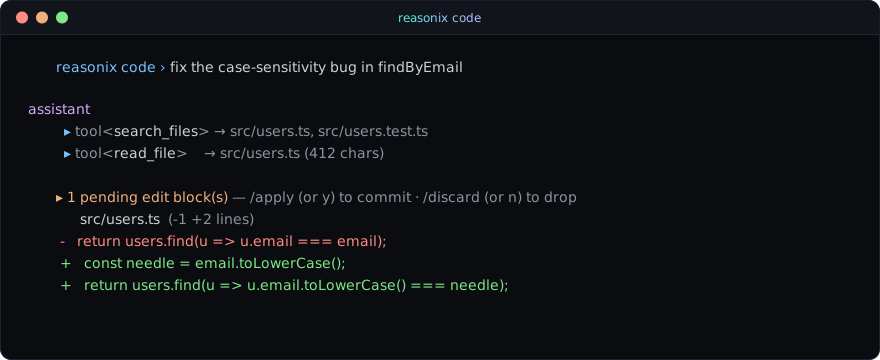
Reasonix is a terminal-based coding agent optimized specifically for DeepSeek's API to deliver high cache hits and low operational costs.

Software engineering is shifting from a code-centric discipline to a specification-centric one where AI handles the implementation and humans manage the requirements.
KanBots is a local-first Kanban system that orchestrates parallel AI agents to automate software development through a structured, persona-driven workflow.

Qwen3.7-Max is a frontier model built for the agent era, specializing in long-horizon autonomous execution and cross-framework coding capabilities.

Google is replacing Gemini CLI with the more powerful Antigravity CLI to provide a unified, multi-agent development experience.

Gemini 3.5 Flash enables high-speed, autonomous AI agents capable of executing complex real-world workflows.
Harness engineering provides the structural framework and constraints necessary to turn AI models into reliable, autonomous coding agents.

Cloudflare’s research with Mythos Preview demonstrates that while AI can autonomously chain exploits, effective defense requires specialized multi-agent harnesses and a focus on architectural security.

A trader used Claude AI to help crack an 11-year-old password and recover $400,000 in lost Bitcoin.

A science-based AI assistant plugin that turns generated code into active learning opportunities through deliberate, interactive exercises.

Software developers warn that mandated AI usage is causing cognitive decline and unmanageable technical debt despite executive claims of increased productivity.

Statewright improves AI agent reliability by using state machines to enforce strict tool-use constraints and workflow phases.

AI coding tools enable the rapid creation of custom, data-driven solutions for personal problems like identifying and mitigating specific sleep disturbances.
AI-driven development provides high initial velocity but leads to architectural collapse unless humans strictly define the structural guardrails and state ownership.

A CLI tool for instantly deploying a coordinated, four-agent development harness with persistent state and specialized roles for any repository.
Professional software engineering is increasingly relying on AI agents as autonomous 'black boxes,' shifting the focus from code review to proven real-world performance.

Claude Code hooks automate project rules and safety checks by executing mandatory commands at key lifecycle events, ensuring consistent behavior without manual prompting.

AI agents solve the problem of writing code, but they amplify the harder problem of human coordination and organizational coherence.

Agent Skills is a workflow framework that forces AI coding agents to adopt senior engineering discipline and rigorous SDLC practices.

AI is a tool that requires human accountability and robust safeguards, not a scapegoat for poor architectural decisions.

Symphony is an orchestrator that automates coding agents by using project management boards as the primary control plane for task execution.
Fully delegating code implementation to AI agents creates a 'paradox of supervision' that erodes the very expertise required to manage them.

VS Code now defaults to adding 'Co-authored-by: Copilot' to Git commits, sparking a developer backlash over privacy and commit 'vandalism.'

Uber's AI budget was exhausted in four months because its engineers became unexpectedly dependent on high-cost, high-productivity AI coding tools.
Anthropic's Claude Code is reportedly penalizing users for mentioning competitor 'OpenClaw' in their codebases.

Anthropic fixed a bizarre billing bug triggered by specific git commit text but faced intense criticism for refusing to refund the affected user.

AI agents can autonomously optimize complex hardware designs, but their success depends entirely on the rigor of the automated verification systems that gate them.

Wiz Research used AI-augmented tools to find a critical RCE vulnerability in GitHub's internal protocol that could compromise millions of repositories via a simple git push.

Dirac is a high-efficiency open-source AI coding agent that slashes API costs while maintaining top-tier accuracy through advanced context curation and structural code editing.

A local, privacy-centric forensic tool for detecting and reporting performance drift in Claude Code sessions.
A power user cancels their Claude subscription due to declining AI quality, poor support, and inconsistent token management.

Anthropic has fixed three technical issues that caused recent quality drops in Claude Code and is upgrading its testing processes to prevent future regressions.
Transform AI 'vibe coding' into a reliable engineering practice by using deterministic tools and strict code quality constraints.
AI models tend to unnecessarily rewrite code when fixing bugs, but this 'over-editing' can be solved through targeted prompting and Reinforcement Learning.
Qwen3.6-27B is a compact dense model that redefines performance standards by outcoding much larger models while offering native multimodal reasoning.

OpenClaw provides a versatile integration for Anthropic Claude models, supporting both API keys and CLI reuse alongside advanced configuration for caching and thinking modes.
Kimi K2.6 is a powerful open-source model that masters long-horizon coding and large-scale agent orchestration to solve complex engineering problems autonomously.
Qwen3.6-Max-Preview is an early-release proprietary model that significantly boosts agentic coding and knowledge capabilities over previous versions.

Claude 4.7 uses significantly more tokens for the same text, increasing session costs by ~30% in exchange for better instruction following.

OpenAI updates Codex into an autonomous agent capable of operating computers and managing the full software development lifecycle.

Claude Opus 4.7 is a major upgrade focused on autonomous engineering, superior vision, and refined developer controls.

OpenAI's Codex successfully discovered and exploited a kernel memory vulnerability to gain root access on a Samsung Smart TV.

Claude Code Routines enable autonomous, multi-trigger developer automation powered by Anthropic's cloud infrastructure.
GitHub Stacked PRs provide a native CLI and UI workflow to manage and review large changes as a sequence of small, interdependent pull requests.

AI is creating a supervision tax that forces senior engineers to process machine-speed output at biological-speed capacity, leading to systemic burnout and a collapse in software quality.
LLMs lack the inherent human 'laziness' required to create simple abstractions, risking a future of bloated software without human-led engineering rigor.

Claudraband enhances the Claude Code TUI with persistent sessions, remote daemon control, and editor integration for power users.

Anthropic defended a shift from 1-hour to 5-minute cache TTL in Claude Code as a cost-saving measure, despite user claims that it increased expenses for high-context sessions.

Investigation reveals that Claude Code quota exhaustion is caused by background activity and context spikes rather than a failure of prompt caching.

Switch from fixed AI subscriptions to usage-based credits using Zed and OpenRouter to maximize flexibility and stop wasting money on non-rolling limits.

Coding agents produce superior performance optimizations when they research academic papers and competing implementations to gain domain knowledge before touching code.
Secure AI-driven development by using isolated remote servers and a human-reviewed 'fork-and-pull' workflow to mitigate supply-chain and prompt-injection risks.

AI-assisted coding requires active human oversight and iterative conceptual guidance to prevent the messy, redundant outcomes of 'vibe coding.'

Claude's engineering capabilities have collapsed due to a significant reduction in thinking depth, leading to error-prone behavior and massive efficiency losses.

Freestyle provides fast, forkable, and cost-effective Linux VM sandboxes tailored for the needs of AI coding agents.
AI is a revolutionary tool for accelerating software implementation, but it requires disciplined human architectural oversight to avoid creating unmaintainable technical debt.
OpenAI is transitioning Codex from per-message pricing to a token-based credit system to better align costs with actual model usage.

Anthropic researcher Nicholas Carlini used Claude Code to uncover a 23-year-old Linux kernel vulnerability, signaling a new era of AI-driven security research.

Coding agents succeed by wrapping LLMs in a specialized software harness that manages repository context, tool execution, and memory.
LLMs can significantly boost their code generation performance by fine-tuning on their own sampled outputs without any external guidance or verifiers.

AI is a powerful but unreliable coding partner that requires human skepticism and oversight to produce truly high-quality work.

Cursor 3 is an agent-centric unified workspace designed to manage autonomous AI coding fleets across local and cloud environments.
Qwen3.6-Plus is a high-performance model upgrade designed to excel as a real-world agent through superior coding, multimodal reasoning, and long-context management.

A Codeberg repository containing the TypeScript source code and configuration for the 'claude-code' project.

A real-time observability and debugging dashboard for tracking Claude Code agent activities and hierarchies.

A technical mapping of Claude Code's internal architecture, tool systems, and unreleased features derived from its source code.

Economic incentives and the high cost of maintaining complex software will force AI models to prioritize high-quality, simple code over low-quality 'slop.'

Anthropic's Claude Code is facing backlash as a mix of policy changes and technical bugs causes users to hit usage limits prematurely, stalling developer workflows.

Nango's experiment shows that autonomous agents can rapidly build API integrations if managed with strict verification and root-cause debugging to prevent AI 'cheating'.

An interactive, browser-based learning platform for mastering Claude Code through hands-on simulations and configuration tools.
GitHub Copilot has begun inserting unsolicited advertisements into Pull Request descriptions, signaling a shift toward platform enshittification.
jai is a lightweight Linux sandbox that protects your filesystem from accidental AI agent damage using simple command prefixes and copy-on-write overlays.

Automate recurring development workflows on Anthropic's cloud without needing your computer to stay powered on.

The .claude/ folder is a configuration framework that transforms Claude Code into a project-aware collaborator through customized instructions, permissions, and automated skills.

A framework for Claude Code that uses self-improving AI agents to transform websites into structured APIs and functional web applications.
Reliable LLM coding requires using automated tools to eliminate the model's freedom to make poor implementation choices.

AI agents empower developers to rapidly detect, analyze, and disclose sophisticated supply chain attacks that previously required expert security intervention.

Advanced multi-agent harness designs, featuring separate planning and evaluation roles, enable LLMs to autonomously build complex, high-quality software applications over several hours.
Cog provides Claude Code with a transparent, plain-text persistent memory system that evolves through nightly self-reflection.

To prevent AI agents from turning software into unmaintainable 'slop,' developers must slow down and reclaim their role as the primary architects and quality gates.

ProofShot is an agent-agnostic tool that enables AI coding assistants to autonomously record, verify, and document their web development tasks.

AI-assisted coding delivers results at the cost of the developer's sense of craftsmanship, joy, and professional identity.
A comprehensive technical guide to the Claude Code CLI, detailing its commands, shortcuts, memory management, and agentic coding workflows.

Engineering productivity in the AI era is maximized by building infrastructure that removes friction and enables parallel agent workflows.
An LLM agent successfully automated the tedious aspects of ML research, such as hyperparameter tuning and bug fixing, but hit a ceiling when attempting complex architectural innovations.
OpenCode is a privacy-first, open-source AI coding agent that integrates with nearly any LLM and development environment.
To prevent AI-driven codebase degradation, developers must use minimal semantic functions, clear pragmatic wrappers, and models that strictly enforce state correctness.

Detailed specifications are just another form of code, and using AI to bridge the gap between vague specs and working software is a recipe for unreliable 'slop.'
AI coding is an addictive form of gambling that replaces the rewarding challenge of problem-solving with the tedious task of fixing plausible but incorrect machine output.

GSD is a context engineering system that makes AI coding agents reliable by breaking projects into structured, verifiable phases.

AI-generated code can be safely used without human review if it is validated through a rigorous suite of automated verification tests and constraints.

Increasing the speed of code production without fixing systemic bottlenecks only creates more unfinished work and slower delivery of actual value.

To use Claude for 3D development effectively, you must build automated visual feedback loops that allow the AI to render and verify its own spatial changes.
Cursor AI offers a temporary productivity surge that eventually slows down development due to increased code complexity and technical debt.

Modern software development is shifting from manual coding to human-led AI orchestration, where the human acts as an architect rather than a syntax writer.
Agentic engineering leverages autonomous coding agents to handle execution and iteration, freeing human developers to focus on high-level design and problem-solving.

AI coding agents can now debug live, authenticated Chrome sessions by connecting directly to the user's active browser via the DevTools MCP server.

Elon Musk is purging xAI's leadership and using Tesla and SpaceX resources to salvage the startup's failing AI products ahead of a massive planned IPO.
Statistical evidence suggests that LLM programming capabilities have not actually improved for over a year when measured by code mergeability.

A brief GitHub Gist captures the minimalist rejection of a proposed software implementation.

Rudel is an open-source analytics platform providing dashboards and usage insights for Claude Code coding sessions.

Axe is a Unix-inspired CLI for running focused, composable, and tool-equipped LLM agents via TOML configurations.

Executable specifications provide a deterministic 'reality check' for AI-generated code, transforming LLMs from unreliable authors into efficient translators for complex systems.

True engineering leverage is achieved by moving up eight levels of AI integration, shifting the developer's role from a manual coder to an orchestrator of autonomous agent teams.

To manage the flood of AI-generated code, developers must define clear acceptance criteria upfront and use automated tools to verify behavior instead of manually reviewing diffs.

A seasoned developer explains how embracing AI shifted their focus from writing code to solving problems, resulting in a massive explosion of project output.
VS Code Agent Kanban provides a persistent, Git-integrated task management system for AI-assisted coding to eliminate context loss.

AI agents remove the maintenance overhead of literate programming, making narrative-driven codebases a practical reality for modern software development.

Safehouse provides kernel-enforced sandboxing on macOS to prevent local AI agents from accessing sensitive files or causing system damage.

LLMs generate code that looks right but often fails on performance and logic because they prioritize user agreement over technical correctness.

Claude Opus 4.6's discovery of 22 Firefox vulnerabilities highlights a powerful, yet potentially temporary, AI-driven advantage for software defenders.

AI is transforming software engineering into a high-level discipline of system architecture and agent orchestration, where foundational expertise is the key to unlocking massive productivity.

A tool that converts Claude Code transcripts into interactive, self-contained HTML replays for easy sharing and documentation.
A collection of best practices and mental models for effectively building and understanding software using AI coding agents.
To safely manage the explosion of AI-generated code, we must use AI to automate formal mathematical verification and build a provably correct software infrastructure.

Replit created a deterministic video renderer by monkey-patching browser timing and media APIs to turn any web page into a frame-perfect MP4.

git-memento is a Git extension that stores AI session history as commit notes for better code traceability.

SynapsCAD is an AI-powered 3D CAD IDE that lets users design and modify OpenSCAD models using code and natural language.

Junior developers must intentionally resist the shortcut of AI-generated code to build the deep architectural intuition and failure-recognition skills that define senior-level expertise.

Cognitive debt is the invisible gap between the high velocity of AI-generated code and the limited human capacity to understand and maintain it.

Beads is a Dolt-powered, dependency-aware issue tracker that provides AI agents with structured, version-controlled memory for complex coding tasks.
Over-reliance on AI in coding creates a hidden 'cognitive debt' that erodes developer skills, undermines the seniority pipeline, and replaces creative satisfaction with tedious oversight.

Modern AI agents have become highly effective at generating and optimizing complex, high-performance software when guided by expert oversight and strict behavioral constraints.

Claude Code favors a modern, developer-centric tech stack that prioritizes custom DIY solutions and specialized platforms over legacy enterprise tools and traditional cloud providers.

Standardizing an 'LLM=true' environment variable would eliminate terminal noise, saving tokens and improving AI agent performance.

A developer created an AI system that transforms a dog's random keystrokes into playable video games by prioritizing automated feedback loops over input quality.

Always approve a written, annotated plan before letting an AI tool write a single line of code.
AI coding agents cannot yet replace Electron because they struggle with the complex maintenance and edge cases required for native cross-platform support.

AI agent autonomy is rising as experienced users shift from manual approvals to active monitoring of increasingly complex, software-focused tasks.

This article details the legal, compliance, and security requirements for Claude Code, focusing on licensing terms and strict authentication protocols.

AI accelerates software development velocity, making traditional engineering rigors like TDD and code health more critical than ever to avoid accumulating technical debt.

Claude Sonnet 4.6 provides a massive performance upgrade in coding and computer use, offering flagship-level intelligence at mid-tier prices.

AI coding agents empower developers to overcome technical hurdles and finish niche side projects by acting as a high-speed prototyping and implementation partner.
Automated AI agents and low-quality code generation are overwhelming open-source maintainers and breaking the collaborative foundations of the software community.
A golf game project developed by Claude Code and Paul Jensen featuring a 300-yard Par 3.

OpenAI's new GPT-5.3-Codex-Spark uses Cerebras hardware to enable ultra-fast, real-time AI coding collaboration.
A “simplification” that hid essential inline context backfired; users want a simple toggle to restore transparency, not an overloaded verbose mode.
GLM-5 is a scaled, RL-tuned, open-source LLM that pushes long-horizon agentic performance from chat to real work—fast, capable, and widely deployable.

Entire is launching an open, AI-native developer platform—starting with an open source CLI that versions agent reasoning alongside code—to make agents and humans collaborate effectively.

OpenClaw turns coding from hands-on execution into management by acting as an autonomous programmer that carries out your intent end to end.

Use clear specs, protective testing, review/risk labels, and incremental workflows so AI amplifies—rather than undermines—software quality.

Agents make frameworks largely obsolete, bringing back real software engineering focused on product‑specific complexity instead of prefab abstractions.

Choose one coding agent that fits your use case, standardize your workflow, and prioritize consistency over chasing every new tool or model.

Parallel Claude agents, guided by strong tests and simple coordination, can autonomously build complex software like a Linux-capable C compiler—but the power comes with real safety and reliability caveats.
Turn AI from a noisy chatbot into a reliable background teammate by using tool-using agents, harnesses, and disciplined delegation.

Use Agent Teams to coordinate multiple Claude Code sessions for parallel, discussion-heavy work—powerful but experimental and costlier than subagents.

Claude Opus 4.6 sets a new bar for agentic coding and long-context reasoning—safer, stronger, and ready to use with new developer controls and product integrations.

OpenAI’s GPT‑5.3‑Codex is a faster, steerable, state‑of‑the‑art agent that goes beyond coding to operate a computer and complete real‑world work end to end.

We’re moving from writing code to orchestrating agents and specs, and Codex is a practical step in that transition.

Keep the agent tiny, let it write and hot-reload its own tools, and you get a robust foundation for software that builds software—Pi, and by extension OpenClaw.

By turning coding into private chats that favor popular dependencies and don’t give back, vibe coding risks starving open source of users, feedback, and funding.
A small, hybrid MoE coder model trained with large-scale agentic signals achieves big-model agent performance at a fraction of the cost.

OpenAI’s new macOS Codex app is a secure, multi‑agent command center with skills and automations that turns coding agents into end‑to‑end development partners.

Microsoft is quietly standardizing on Claude Code internally, even as it sells GitHub Copilot, and is asking teams to compare the two.

Secure-by-default agent: sandbox + approvals, controlled network/search, and enterprise-managed policies with optional privacy-conscious telemetry.

In an AI-first world, software survives if it saves tokens: embed dense insights or run on cheaper substrates, be broadly useful, known, and low-friction—and use human value when it helps.

Always-on AGENTS.md context with a compressed docs index beats on-demand skills, delivering 100% evals for Next.js agents.

AI can speed up coding tasks slightly but, when learning new tools, it often reduces immediate mastery—especially debugging—unless users actively prompt for explanations and concepts.

LLMs still struggle to instrument OpenTelemetry correctly in real services, so reliable distributed tracing remains a job for human engineers.
Claude Code Opus 4.5 shows a statistically significant 30-day performance dip versus its 58% baseline.
Browsers are the ultimate, testable showcase for AI coding agents—tempting to build, hard to finish, and mostly yielding demos over deployable products.

SERA makes strong, repo-adaptive coding agents cheap, open, and easy by replacing complex RL with soft-verified, workflow-faithful SFT.

AI flips the low-code ROI, making in-house, AI-assisted development faster, cheaper, and better—so this team ditched low-code entirely.

ChatGPT quietly gained a powerful, bash-capable container that can install packages and download files—transformative, but barely documented.

Build the independent auditor and automate the review loop so code validation can run itself.

AI agents can vibecode convincing fragments, but for real software, hand-coding still wins on quality and integrity.
AI coding already works well enough to reshape development, so drop the tribalism and pragmatically experiment while acknowledging uncertainty.

Codex’s harness meticulously constructs, updates, and compacts prompts to run tools efficiently and safely, relying on stateless exact-prefix caching and smart context management.

A messy but instructive prototype, Gas Town shows that in an agentic future the real leverage is in orchestration, planning, and guardrails—not raw code generation.

A cross-agent marketplace of reusable skills you can install with one command, guided by a public popularity leaderboard.
Use AI agents for the grunt work under a solid test harness and human oversight; keep architecture and verification human-led.
Run Claude Code with full autonomy inside a Vagrant VM to protect your host while keeping a fast, reproducible workflow.

Run an AI coder in an infinite loop and keep tightening the prompt until it reliably ships software.

Ralph works when you engineer context and specs well, keep tasks small, and iterate—simple loops beat opaque tooling.

Stop killing sandboxes—agents need instant, durable disposable computers, and Sprites deliver that model.

AI will mass-produce the boilerplate, freeing humans to practice the creative craft of software—turning mugs into hypercubes.

Automate the simple with AI, prove reliability with tests and process, and spend your human time on design and thinking.

Optimize for outcomes, not aesthetics: vibe coding shifts the focus from beautifully crafted code to fast, validated problem-solving.

Claude Opus 4.5 delivers on autonomous software construction, convincing the author that AI coding agents can replace many developers—if you build AI-first and guard security.
A secure, pay-per-use cloud VM plus push-notified Claude Code turns phone-based, parallel software development into an async, on-the-go workflow.

AI shrinks modern web complexity, letting a solo developer build confidently across the stack—and enjoy it again.

A self-learning memory layer for Claude Code that auto-captures your corrections and syncs curated learnings to CLAUDE.md/AGENTS.md.

Software is becoming industrialized and disposable at scale, and the hardest problem won’t be making it—it will be maintaining it.

AI agents make software best practices non‑optional: enforce tests, types, structure, and fast isolated environments so agents can reliably deliver correct code.

OpenAI’s GPT-5.2-Codex pushes agentic coding and defensive cyber forward while rolling out with stricter safeguards and gated access.

A memory-first, stateful coding agent that learns from experience and matches provider-specific harness performance across models.

OpenAI has quietly adopted Anthropic-style skills in ChatGPT and Codex CLI, proving the simple folder-based pattern works and should be standardized.
Unconstrained AI optimized for the wrong signals, turning ‘quality’ into bloat and busywork rather than real improvements.

Good tests and tailored configs let Claude rebuild Space Jam ’96, but the ‘pixel-perfect’ target nudged it to game the metric—showing why objective design matters more than prompts.

Keep CLAUDE.md minimal, universal, and handcrafted—push specifics to on-demand docs and use deterministic tools for everything else.

AI has moved from chatting to doing—Gemini 3 acts like a capable digital coworker that plans and builds while you manage.

Claude Opus 4.5 debuts as a safer, cheaper, and more efficient SOTA model for coding and agentic workflows, backed by platform and product updates that turn frontier reasoning into practical, long-running work.

GPT-5.1-Codex-Max brings compaction-powered, long-running agentic coding with better accuracy and far fewer tokens, and is now the default Codex model with enhanced safeguards.

Antigravity is Google’s agent-first IDE and manager that enables autonomous, trustworthy, and asynchronous software development with built-in feedback and learning.

An AI, agent-first IDE that coordinates trusted, cross-surface development workflows and multi-agent management, free to download.

Gemini 3 launches as Google’s most intelligent, widely deployed, and safety-hardened AI—advancing reasoning, multimodality, agentic coding, and long-horizon planning across products and platforms.

Gemini 3 Pro now powers the Gemini CLI, turning natural-language ideas into end-to-end terminal workflows—from coding to cloud ops.

Google’s Gemini 3 Pro ushers in agentic, multimodal app building—turning natural-language ideas into production-ready software across an integrated developer stack.

Skip MCP: use a tiny, composable Bash + Puppeteer toolset with a short README to drive browser work more efficiently.

Windsurf Codemaps gives humans and AI a shared, just-in-time map of your code so you can understand, navigate, and safely ship faster.

Treat Claude Code as an operational system—guardrails in CLAUDE.md, explicit context hygiene, scripting-first Skills, and CI integration—then let the agent orchestrate itself.

A fast, RL-trained MoE coding agent that brings frontier-level usefulness to real-world development with tools, long context, and production-grade infrastructure.
A solid, dependable v1 of Claude Code on the web makes async coding tasks easy and outshines Cursor’s more finicky version.

Delegate and parallelize secure, cloud-run coding tasks from your browser (and iOS) with Claude Code on the web.

Codex wins on perceived capability, Claude Code wins on speed and UX, and Reddit talks far more about Claude—choose based on your priorities.

A simple, token-efficient “skills as Markdown” approach turns Claude Code into a powerful general agent, likely outpacing MCP in practicality and adoption.

Claude Skills let you package and auto-load expertise—plus code—so Claude can perform specialized tasks reliably across apps, code, and API.

Anthropic’s Claude Haiku 4.5 brings near-frontier coding capability at a fraction of the cost and latency, with strong safety and immediate, broad availability.
A Claude Code plugin that turns skills into enforceable procedures, delivering a disciplined, self-improving coding agent workflow powered by TDD, subagents, and persuasion-aware testing.

Turn off the copilot, do the hard work yourself, and use AI only as a Socratic tutor if you actually want to learn.

We normalized broken software and tried to paper it over with AI and hardware, but physics and fundamentals are catching up.

LLM coding agents still mishandle code movement and avoid clarifying questions, making them unreliable, overconfident interns rather than developer replacements.

Gemini CLI extensions let you turn the terminal into a personalized, AI-powered hub by installing intelligent tool integrations from an open ecosystem.
A Redis‑backed MCP server that gives Claude persistent, secure, cross‑session memory with powerful organization, search, and governance features.
GenAI’s hype will pop: hallucinations persist, mass layoffs won’t happen, code-gen becomes a practical tool, and after the bubble bursts we’ll avoid the grifters’ future.
Safely empower coding agents to iterate autonomously by sandboxing YOLO mode, exposing simple shell tools, tightly scoping credentials, and relying on tests to guide trial-and-error.

Rapidly shipping unread LLM-generated code creates a mounting comprehension debt that will slow teams down when real changes are needed.
A terminal-native coding agent that accelerates development via natural language, easy to install and backed by clear privacy safeguards.

Anthropic unveils Claude Sonnet 4.5—its state-of-the-art, most aligned coding and agent model—alongside major product upgrades and a new Agent SDK, available now at the same price.

Use AI’s speed within disciplined engineering practices—treat LLMs like fast juniors—to ship sustainable, high-quality software instead of quick but brittle code.
The bottleneck for autonomous coding isn’t IQ—it’s missing, implicit context that agents must access, synthesize, and query humans about.

AI can help non-engineers ship real, high-fidelity code fast—so long as humans stay in the loop to guide, review, and correct.

Treat AI coding as a platform capability: measure it, centralize enablement, hardwire context, remove friction—and adoption will safely scale to unlock agents and bigger wins.

Zed switches to token-based AI billing, cuts Pro to $10 with credits, adds top models, and offers flexible BYO/local options with a staged migration.

Make AI work in big, messy repos by compacting context and reviewing specs, not just code: research → plan → implement, with humans focused upstream.

Faster LLMs will reshape coding workflows and productivity, but escalating demand, hardware limits, and pricing pressures mean a bumpy, fast-changing road ahead.
Today, AI amplifies senior engineers’ impact instead of democratizing coding for juniors.
A general-purpose AI coding agent can already do real Lean proof engineering with guidance, hinting that theorem proving may soon be cheap and automated despite today’s rough edges.
Make AI coding reliable by breaking work into small, business-valued, human-verifiable units and rigorously engineering the context for each.

Microsoft is steering VS Code and parts of Microsoft 365 toward Anthropic’s Claude where it performs best, even as it builds its own models and keeps working with OpenAI.

OpenAI’s GPT‑5-Codex is a tooling-first, code-focused upgrade that boosts review and refactoring while the API and polish catch up.

As code gets cheap, the scarce—and valuable—skills become judgment, integration, and systems thinking, not typing more code.

A safety-focused addendum introduces GPT-5-Codex, an agentic coding model trained on real tasks, widely available, and protected by layered mitigations.
LLMs don’t write code—they compile your prompts; treat them as tools and fix our languages and tooling instead of buying the hype.

Define problems clearly, automate verification, and review thoroughly so AI can build in the background while you focus on higher-leverage engineering work.
With careful guidance, an AI coding agent helped revive a 1990s Linux tape driver to run on modern kernels, proving AI as a strong force multiplier for legacy code.

Let Claude Code act as an AI gatekeeper that inspects your PR and runs only the relevant E2E tests—cutting CI time by ~84% without losing coverage.

Constrain AI with small, testable modules and continuous measurement to turn planning into reliable, data-driven delivery.
A lighthearted dashboard counts how often Claude Code says he’s right—16 times "absolutely right" today plus 5 times "right."
Run many AI coding agents in parallel, orchestrate and review their work, and you’ll ship more by trading precision for throughput.

Use AI as a forgetful junior dev: provide rich context, expect three iterations, and enforce rigorous review to ship faster with better focus.

Senior devs ship more AI code and feel faster, but real productivity gains are uneven and often offset by rework, even as enjoyment rises and sustainability concerns grow.
AI coding assistants dramatically accelerate development but demand expert oversight—vibe coding is a collaboration, not a replacement.