Jevmem: Automated Project Memory for AI Coders
jevmem provides a fast, automated, and cost-effective persistent memory layer for AI coding assistants to track project decisions and constraints.
Build systems, CLI tools, package managers, and other infrastructure that supports the software development process, including their configuration and optimization.
jevmem provides a fast, automated, and cost-effective persistent memory layer for AI coding assistants to track project decisions and constraints.
To unlock the true potential of AI agents, engineering teams must transition from simple automation to building agent-legible development environments that support autonomous maintenance.

A community-driven platform for engineers to share, compare, and learn from each other's complex AI development setups.
A technical reference cataloging the functional tools and instructional skills that empower the Codex AI ecosystem.

Gemini Omni 1.1 Flash empowers developers with professional-grade generative video controls, high-resolution output, and cost-effective drafting tools.

A comprehensive pricing guide for OpenAI's 2026 API suite, covering GPT-5.6, multimodal generation, and integrated developer tools.

LLMs provide a significant 2x productivity boost for verifiable tasks, but human expertise remains the bottleneck for code architecture and documentation.

OpenAI Codex Security is a developer toolset for automated vulnerability scanning and remediation in code repositories.

clawk provides secure, disposable Linux VMs for AI coding agents to work autonomously without risking the host machine.
Improve AI reliability by surrounding non-deterministic LLMs with deterministic tools and allowing them to script their own automated workflows.

A local tool that optimizes video for LLMs by extracting scene-change frames and transcripts while minimizing redundant data.

Claude Code uses hidden Unicode markers in system prompts to silently fingerprint API gateways and user environments.

A high-performance, secure LLM router that optimizes model selection per request to reduce costs and improve accuracy for agentic systems.

Cloudflare has democratized its OAuth platform, enabling all developers to build secure integrations following a high-performance infrastructure upgrade.

Local LLMs have finally reached a performance threshold where they can reliably perform complex agentic coding tasks on consumer hardware.

A developer creates an asynchronous, GitHub-integrated pipeline to automate coding tasks while maintaining human control over design and quality.

Container machine creates a seamless, persistent Linux development environment on macOS with native file sharing and system service support.

Microsoft is investigating a supply chain attack where hackers compromised over 70 open-source repositories to steal passwords from AI and cloud developers.

Core AI is Apple's high-performance framework for deploying and optimizing neural networks on Apple silicon.
A flaw in VSCode's keyboard event handling allows malicious repositories to steal GitHub tokens on github.dev by automatically installing rogue extensions.

Claude Code contains a hidden layer of advanced, programmable features for persistent memory and autonomous command execution not found in official documentation.

Claude Code can now orchestrate hundreds of parallel agents to complete massive, end-to-end engineering tasks in days rather than months.

Cloudflare Flagship is a feature flag service for safe, targeted, and standard-compliant feature rollouts across the Cloudflare network and beyond.
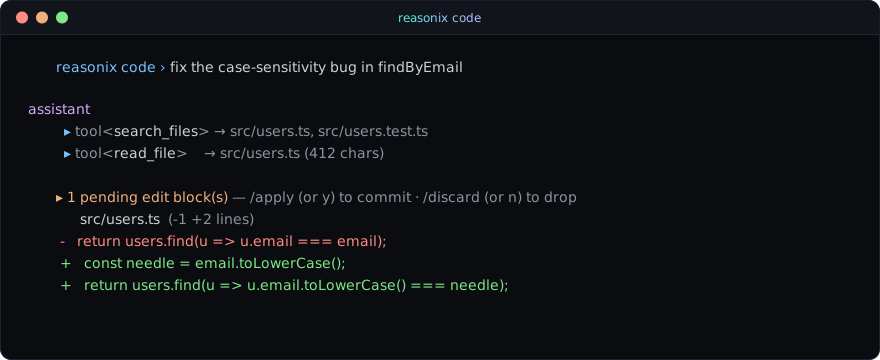
Reasonix is a terminal-based coding agent optimized specifically for DeepSeek's API to deliver high cache hits and low operational costs.

GitHub suffered an internal repository breach after an employee installed a malicious VS Code extension, with hackers now attempting to sell the stolen code.

Google is replacing Gemini CLI with the more powerful Antigravity CLI to provide a unified, multi-agent development experience.

Forge is a specialized LLM framework for standardizing model orchestration and rigorous performance evaluation across local and cloud backends.

A lightweight Python tool for managing secure, project-specific development environments via rootless Podman containers.

Secure your pnpm projects by quarantining new releases, blocking exotic subdependencies, and restricting build scripts.

A CLI tool for instantly deploying a coordinated, four-agent development harness with persistent state and specialized roles for any repository.

Claude Code hooks automate project rules and safety checks by executing mandatory commands at key lifecycle events, ensuring consistent behavior without manual prompting.

Wiki Builder is a Claude Code plugin that automates the creation and maintenance of structured markdown knowledge bases for AI agents.

VS Code now defaults to adding 'Co-authored-by: Copilot' to Git commits, sparking a developer backlash over privacy and commit 'vandalism.'
Automating screenshot generation through a build pipeline ensures documentation stays perfectly in sync with UI updates.

DeepSeek's API allows developers to access advanced AI models using familiar OpenAI-compatible SDKs and simple configuration changes.
Transform AI 'vibe coding' into a reliable engineering practice by using deterministic tools and strict code quality constraints.

Claude Opus 4.7's new tokenizer increases token counts for the same data, effectively raising costs despite unchanged per-token pricing.
Slop Cop is a writing editor that identifies and helps eliminate the generic, predictable patterns found in AI-generated text.

OpenAI updates Codex into an autonomous agent capable of operating computers and managing the full software development lifecycle.

Cloudflare Email Service is now in public beta, enabling AI agents to use email as a bidirectional, stateful interface for global communication and asynchronous task management.

ClawRun is a comprehensive lifecycle and hosting platform for deploying, managing, and cost-tracking AI agents in secure sandboxes.
GitHub Stacked PRs provide a native CLI and UI workflow to manage and review large changes as a sequence of small, interdependent pull requests.

Claudraband enhances the Claude Code TUI with persistent sessions, remote daemon control, and editor integration for power users.

Anthropic defended a shift from 1-hour to 5-minute cache TTL in Claude Code as a cost-saving measure, despite user claims that it increased expenses for high-context sessions.

Switch from fixed AI subscriptions to usage-based credits using Zed and OpenRouter to maximize flexibility and stop wasting money on non-rolling limits.

OpenScreen is a free, open-source tool for creating professional-looking product demos with advanced zoom and editing features.

A massive repository update providing a comprehensive technical library for ClickHouse database management, optimization, and troubleshooting.

Cursor 3 is an agent-centric unified workspace designed to manage autonomous AI coding fleets across local and cloud environments.

A Codeberg repository containing the TypeScript source code and configuration for the 'claude-code' project.

A real-time observability and debugging dashboard for tracking Claude Code agent activities and hierarchies.

An interactive, browser-based learning platform for mastering Claude Code through hands-on simulations and configuration tools.

lat.md creates a searchable, validated markdown knowledge graph that links documentation directly to source code for better project scaling and AI context.
jai is a lightweight Linux sandbox that protects your filesystem from accidental AI agent damage using simple command prefixes and copy-on-write overlays.

Automate recurring development workflows on Anthropic's cloud without needing your computer to stay powered on.

The .claude/ folder is a configuration framework that transforms Claude Code into a project-aware collaborator through customized instructions, permissions, and automated skills.

FastMCP is the standard Python framework for building, connecting, and deploying Model Context Protocol applications.

AI productivity gains are currently visible only in the development of AI-related software, not in the broader software industry.
A comprehensive technical guide to the Claude Code CLI, detailing its commands, shortcuts, memory management, and agentic coding workflows.

Engineering productivity in the AI era is maximized by building infrastructure that removes friction and enables parallel agent workflows.
OpenCode is a privacy-first, open-source AI coding agent that integrates with nearly any LLM and development environment.

To use Claude for 3D development effectively, you must build automated visual feedback loops that allow the AI to render and verify its own spatial changes.

AI coding agents can now debug live, authenticated Chrome sessions by connecting directly to the user's active browser via the DevTools MCP server.

GitAgent turns Git repositories into version-controlled, framework-agnostic AI agents with built-in governance and modular skills.

A hardware compatibility tool that grades the local performance of AI models based on a user's specific GPU and VRAM configuration.

Rudel is an open-source analytics platform providing dashboards and usage insights for Claude Code coding sessions.

Axe is a Unix-inspired CLI for running focused, composable, and tool-equipped LLM agents via TOML configurations.
VS Code Agent Kanban provides a persistent, Git-integrated task management system for AI-assisted coding to eliminate context loss.

AI agents remove the maintenance overhead of literate programming, making narrative-driven codebases a practical reality for modern software development.

A tool that converts Claude Code transcripts into interactive, self-contained HTML replays for easy sharing and documentation.

A dynamic, AI-ready CLI for Google Workspace that automates API interactions for both humans and LLMs.

A stolen Gemini API key led to an $82,000 bill in 48 hours, highlighting the urgent need for cloud billing limits.

An interactive browser-based tool for visualizing, debugging, and experimenting with Web Audio API signal chains in real time.

git-memento is a Git extension that stores AI session history as commit notes for better code traceability.

SynapsCAD is an AI-powered 3D CAD IDE that lets users design and modify OpenSCAD models using code and natural language.

Google is reinstating Gemini CLI users banned for ToS violations and introducing a self-service 'two-strike' enforcement system.

A terminal utility that turns Git repository history and contributor data into a scrolling movie-style credit sequence.

Beads is a Dolt-powered, dependency-aware issue tracker that provides AI agents with structured, version-controlled memory for complex coding tasks.

Anthropic is giving 10,000 open-source maintainers six months of free Claude Max access as a token of appreciation for their work.

Claude Code favors a modern, developer-centric tech stack that prioritizes custom DIY solutions and specialized platforms over legacy enterprise tools and traditional cloud providers.

Standardizing an 'LLM=true' environment variable would eliminate terminal noise, saving tokens and improving AI agent performance.

Cloudflare's vinext is an AI-built, Vite-powered replacement for Next.js that optimizes serverless deployment and drastically improves performance.

A developer created an AI system that transforms a dog's random keystrokes into playable video games by prioritizing automated feedback loops over input quality.

Always approve a written, annotated plan before letting an AI tool write a single line of code.
AI coding agents cannot yet replace Electron because they struggle with the complex maintenance and edge cases required for native cross-platform support.
AI should be viewed as a cognitive exoskeleton that amplifies human judgment and capability rather than an autonomous replacement for human workers.

This article details the legal, compliance, and security requirements for Claude Code, focusing on licensing terms and strict authentication protocols.
WebMCP is a JavaScript API that allows web applications to provide executable tools and context to AI agents.
A “simplification” that hid essential inline context backfired; users want a simple toggle to restore transparency, not an overloaded verbose mode.

Entire is launching an open, AI-native developer platform—starting with an open source CLI that versions agent reasoning alongside code—to make agents and humans collaborate effectively.
Turn natural-language Markdown into secure, AI-driven GitHub Actions that continuously improve and manage your repositories.

Use clear specs, protective testing, review/risk labels, and incremental workflows so AI amplifies—rather than undermines—software quality.

Agents make frameworks largely obsolete, bringing back real software engineering focused on product‑specific complexity instead of prefab abstractions.

Choose one coding agent that fits your use case, standardize your workflow, and prioritize consistency over chasing every new tool or model.

Stop database sprawl—Postgres (with extensions) now does almost everything well enough in one place.
Turn AI from a noisy chatbot into a reliable background teammate by using tool-using agents, harnesses, and disciplined delegation.

Use Agent Teams to coordinate multiple Claude Code sessions for parallel, discussion-heavy work—powerful but experimental and costlier than subagents.

Claude Opus 4.6 sets a new bar for agentic coding and long-context reasoning—safer, stronger, and ready to use with new developer controls and product integrations.

OpenAI’s GPT‑5.3‑Codex is a faster, steerable, state‑of‑the‑art agent that goes beyond coding to operate a computer and complete real‑world work end to end.

Treat the organization itself as code—modeled in a versioned, queryable graph with a DSL—to automate compliance, analyze impact, and manage change.

We’re moving from writing code to orchestrating agents and specs, and Codex is a practical step in that transition.

Keep the agent tiny, let it write and hot-reload its own tools, and you get a robust foundation for software that builds software—Pi, and by extension OpenClaw.
Fluid lets you safely experiment in a sandbox and then export your steps as an auditable, reproducible Ansible playbook.

Use bubblewrap to run AI coding agents with broad in-sandbox permissions but tightly scoped, project-only access on the host.

Deno Sandbox securely runs and ships untrusted/LLM code by combining microVM isolation, secret shielding, and strict egress controls with one-click deployment to Deno Deploy.

An open, portable standard to give AI agents on-demand expertise, workflows, and context they can load when needed.

OpenAI’s new macOS Codex app is a secure, multi‑agent command center with skills and automations that turns coding agents into end‑to‑end development partners.

Microsoft is quietly standardizing on Claude Code internally, even as it sells GitHub Copilot, and is asking teams to compare the two.

Secure-by-default agent: sandbox + approvals, controlled network/search, and enterprise-managed policies with optional privacy-conscious telemetry.

In an AI-first world, software survives if it saves tokens: embed dense insights or run on cheaper substrates, be broadly useful, known, and low-friction—and use human value when it helps.

Always-on AGENTS.md context with a compressed docs index beats on-demand skills, delivering 100% evals for Next.js agents.
Figma Make prototypes can be reverse-engineered into a runnable React app by unzipping the .make file, decoding its Kiwi-based canvas.fig, and auto-fixing imports, assets, and configs.

Turn doc-update decisions into a legal-style, evidence-backed courtroom so LLMs reason better and teams trust the results.

AI flips the low-code ROI, making in-house, AI-assisted development faster, cheaper, and better—so this team ditched low-code entirely.

ChatGPT quietly gained a powerful, bash-capable container that can install packages and download files—transformative, but barely documented.

Build the independent auditor and automate the review loop so code validation can run itself.

Codex’s harness meticulously constructs, updates, and compacts prompts to run tools efficiently and safely, relying on stateless exact-prefix caching and smart context management.

A cross-agent marketplace of reusable skills you can install with one command, guided by a public popularity leaderboard.
Run Claude Code with full autonomy inside a Vagrant VM to protect your host while keeping a fast, reproducible workflow.

Stop killing sandboxes—agents need instant, durable disposable computers, and Sprites deliver that model.

Automate the simple with AI, prove reliability with tests and process, and spend your human time on design and thinking.
A secure, pay-per-use cloud VM plus push-notified Claude Code turns phone-based, parallel software development into an async, on-the-go workflow.

A self-learning memory layer for Claude Code that auto-captures your corrections and syncs curated learnings to CLAUDE.md/AGENTS.md.

AI agents make software best practices non‑optional: enforce tests, types, structure, and fast isolated environments so agents can reliably deliver correct code.

OpenAI has quietly adopted Anthropic-style skills in ChatGPT and Codex CLI, proving the simple folder-based pattern works and should be standardized.

Good tests and tailored configs let Claude rebuild Space Jam ’96, but the ‘pixel-perfect’ target nudged it to game the metric—showing why objective design matters more than prompts.

Stop grading AI with more AI—enforce hard, deterministic guardrails with code, not vibes.

Keep CLAUDE.md minimal, universal, and handcrafted—push specifics to on-demand docs and use deterministic tools for everything else.

Claude can now discover, orchestrate, and use large tool ecosystems efficiently through on-demand discovery, code-driven execution, and example-guided invocation.

Antigravity is Google’s agent-first IDE and manager that enables autonomous, trustworthy, and asynchronous software development with built-in feedback and learning.

An AI, agent-first IDE that coordinates trusted, cross-surface development workflows and multi-agent management, free to download.

Gemini 3 Pro now powers the Gemini CLI, turning natural-language ideas into end-to-end terminal workflows—from coding to cloud ops.

Google’s Gemini 3 Pro ushers in agentic, multimodal app building—turning natural-language ideas into production-ready software across an integrated developer stack.

Skip MCP: use a tiny, composable Bash + Puppeteer toolset with a short README to drive browser work more efficiently.

Windsurf Codemaps gives humans and AI a shared, just-in-time map of your code so you can understand, navigate, and safely ship faster.

Treat Claude Code as an operational system—guardrails in CLAUDE.md, explicit context hygiene, scripting-first Skills, and CI integration—then let the agent orchestrate itself.

A fast, RL-trained MoE coding agent that brings frontier-level usefulness to real-world development with tools, long context, and production-grade infrastructure.

Tinker deliberately and often—experiment, discard, and refine—to learn faster and develop personal taste.
A solid, dependable v1 of Claude Code on the web makes async coding tasks easy and outshines Cursor’s more finicky version.

A portable toolkit that turns plain async TypeScript functions into durable, observable workflows with minimal code and no infrastructure plumbing.

Delegate and parallelize secure, cloud-run coding tasks from your browser (and iOS) with Claude Code on the web.

Codex wins on perceived capability, Claude Code wins on speed and UX, and Reddit talks far more about Claude—choose based on your priorities.

A simple, token-efficient “skills as Markdown” approach turns Claude Code into a powerful general agent, likely outpacing MCP in practicality and adoption.

Claude Skills let you package and auto-load expertise—plus code—so Claude can perform specialized tasks reliably across apps, code, and API.
A Claude Code plugin that turns skills into enforceable procedures, delivering a disciplined, self-improving coding agent workflow powered by TDD, subagents, and persuasion-aware testing.

Gemini CLI extensions let you turn the terminal into a personalized, AI-powered hub by installing intelligent tool integrations from an open ecosystem.
A Redis‑backed MCP server that gives Claude persistent, secure, cross‑session memory with powerful organization, search, and governance features.

A central hub to plan, build, and deploy high-quality ChatGPT apps with the Apps SDK, available in preview now.

Solveit is a human-in-the-loop, Polya-inspired AI workspace that turns iterative, small-step coding into compounding mastery—backed by a five-week course starting Oct 20.
Safely empower coding agents to iterate autonomously by sandboxing YOLO mode, exposing simple shell tools, tightly scoping credentials, and relying on tests to guide trial-and-error.
A sprawling monthly HN showcase of indie and open-source projects, with pragmatic AI layered on solid, privacy‑minded tooling across software, hardware, and real‑world domains.
A terminal-native coding agent that accelerates development via natural language, easy to install and backed by clear privacy safeguards.

Anthropic unveils Claude Sonnet 4.5—its state-of-the-art, most aligned coding and agent model—alongside major product upgrades and a new Agent SDK, available now at the same price.

Standardize LLM observability on OpenTelemetry, enrich it with AI-specific attributes, and help evolve OTel’s GenAI semantics instead of fragmenting on multiple standards.

AI can help non-engineers ship real, high-fidelity code fast—so long as humans stay in the loop to guide, review, and correct.

Treat AI coding as a platform capability: measure it, centralize enablement, hardwire context, remove friction—and adoption will safely scale to unlock agents and bigger wins.

Zed switches to token-based AI billing, cuts Pro to $10 with credits, adds top models, and offers flexible BYO/local options with a staged migration.

Microsoft is steering VS Code and parts of Microsoft 365 toward Anthropic’s Claude where it performs best, even as it builds its own models and keeps working with OpenAI.

OpenAI’s GPT‑5-Codex is a tooling-first, code-focused upgrade that boosts review and refactoring while the API and polish catch up.

Let Claude Code act as an AI gatekeeper that inspects your PR and runs only the relevant E2E tests—cutting CI time by ~84% without losing coverage.

Ditch Docker’s privileged daemon for Podman’s rootless, daemonless, Kubernetes-aligned workflow that’s more secure and just as easy to use.
Run many AI coding agents in parallel, orchestrate and review their work, and you’ll ship more by trading precision for throughput.

AI is entering grantmaking as a large-scale screening tool that can speed and potentially democratize funding, but bias and confidentiality concerns mean it should augment—not replace—human reviewers.