Reasonix: The High-Efficiency DeepSeek-Native Coding Agent
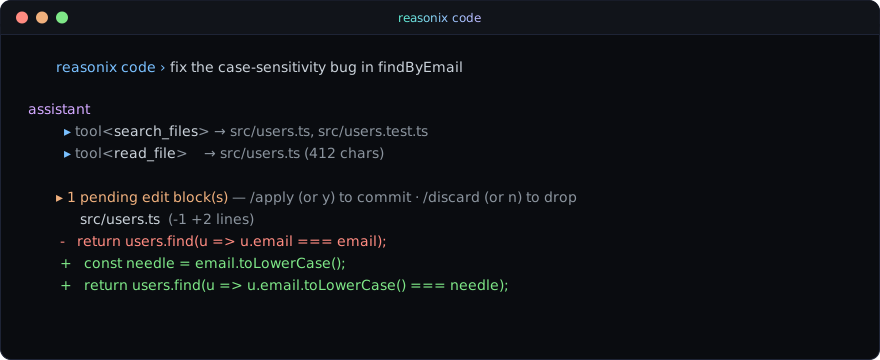
Reasonix is an open-source coding agent built to maximize the cost-efficiency of the DeepSeek API through specialized cache management. It provides a terminal-native TUI and a desktop client that support external tools via MCP and custom Markdown-based skills. The system prioritizes developer control with sandboxed execution and a plan-based approval workflow for all file edits.
Key Points
- DeepSeek-Native Optimization: Engineered specifically for DeepSeek's byte-stable prefix cache to achieve high efficiency and significant cost reductions.
- Terminal-First Design: Focuses on a TUI (Text User Interface) that works alongside standard terminal tools like git and ls rather than acting as an IDE replacement.
- Extensibility: Supports first-class MCP integration for external tools and a Markdown-based 'skills' system for reusable playbooks.
- Security and Control: Features a sandboxed environment and a mandatory audit gate for code changes to ensure safe execution.
- Dual Interface: Offers both a lightweight CLI/TUI and a cross-platform Tauri desktop application with live cost and token monitoring.
Sentiment
The overall sentiment is mixed but leans skeptical. Commenters largely agree that DeepSeek's pricing and prefix caching are important, and some are enthusiastic about cheaper coding workflows, but the thread pushes back hard on claims that Reasonix is uniquely DeepSeek-native or technically differentiated. The strongest consensus is that cache-aware harness design matters, while the article needs clearer evidence, benchmark comparisons, and a more trustworthy presentation to win broader confidence.
In Agreement
- A cache-first, byte-stable agent loop can materially reduce DeepSeek API cost and latency during long coding sessions.
- Generic harnesses can accidentally damage caching by changing early prompt content, tool definitions, system metadata, or compacted history, so an opinionated design that preserves stable prefixes has practical value.
- DeepSeek's low cost makes it compelling for coding workflows, especially when paired with planning, review, or guardrails from other tools.
- Support for self-hosted endpoints, MCP, schema-aware tool-call repair, and a terminal-native workflow are useful engineering choices for developers who want direct control over their agent stack.
- The project should be judged as an open-source contribution rather than as a polished commercial product, and the rough website does not necessarily invalidate the underlying idea.
Opposed
- The article overstates novelty because mature coding agents already preserve prompt prefixes well enough to benefit from provider-side caching.
- Reasonix needs comparative benchmarks against OpenCode, Claude Code, Pi, Crush, Codex, and other harnesses before its cache-efficiency claims are persuasive.
- Append-only context is not automatically optimal because pruning, compaction, and prompt reshaping can improve model behavior and reduce total cost despite partial cache disruption.
- A model-specific harness may be unnecessary when existing tools can point at DeepSeek or OpenRouter-compatible endpoints and provide a more mature experience.
- Trust, data exposure, supply-chain risk, JavaScript runtime overhead, UI glitches, and an AI-looking website all weaken confidence in adopting the tool.