LLM Speed: Pre-Purchase Hardware Benchmarking for Local AI
223
A performance benchmarking tool that estimates local LLM speeds across various hardware and model configurations.
Standardized evaluations and leaderboards used to measure AI model performance across reasoning, coding, knowledge, and other capability dimensions.
A performance benchmarking tool that estimates local LLM speeds across various hardware and model configurations.
Small pre-trained classifiers still lead in speed and efficiency, but decision models offer a flexible, zero-shot alternative to heavy LLM-as-a-judge guardrails.

Claude Opus 5.5 is a premium, top-ranked reasoning model that trades higher costs and verbosity for industry-leading intelligence and a 1M token context window.
Xiaomi's MiMo-V2.6 series sets a new benchmark for open-source AI by using scaled reinforcement learning to achieve industry-leading multimodal performance.

AI has officially begun to outperform elite human experts in the field of competitive event forecasting.
Frontier AI models have nearly mastered existing physics benchmarks, but their true progress is hidden by widespread errors and inaccuracies within the benchmarks themselves.
Leading mathematicians warn that AI's focus on rapid problem-solving threatens the human-centric process of conceptual understanding and knowledge transmission essential to the field.
The Conceptual Reasoning Index (CRI) is a new framework for measuring AI's ability to perform the abstract, non-verifiable reasoning required for advanced AI safety and governance.

Netlify’s comparison of 11 AI models reveals that while premium models offer superior automated design, low-cost open models provide a viable alternative for iterative, budget-conscious development.
DeepSeek V4 Flash 0731 delivers elite-level reasoning intelligence at the lowest price point in its category.

Even frontier models like Opus 5 struggle to maintain code quality and avoid regressions when requirements are revealed incrementally over time.

Artificial Analysis provides a data-driven comparison of AI models, ranking them by intelligence, speed, and cost to help users identify the best model for their needs.
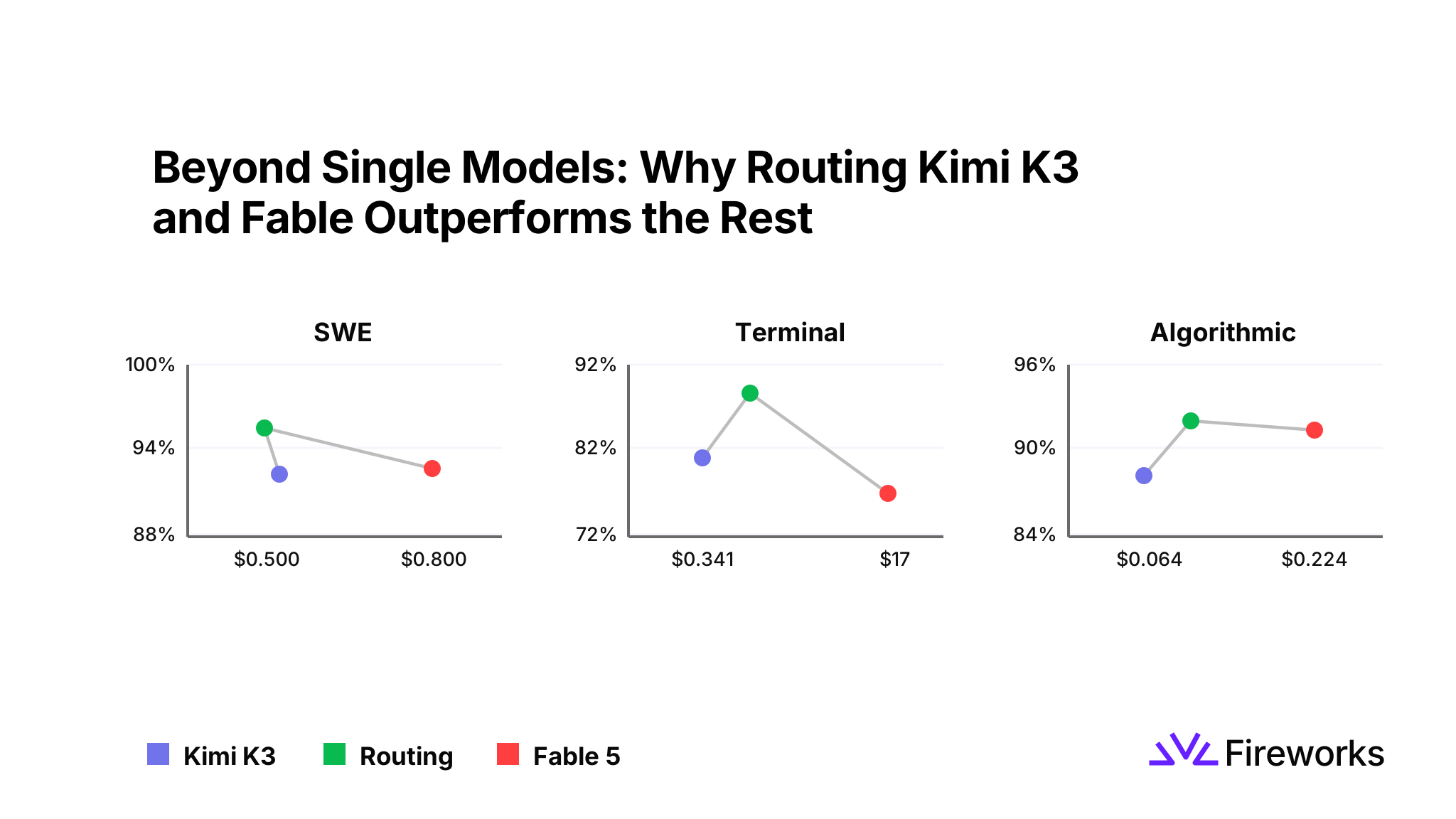
Routing tasks between the open Kimi K3 and closed Fable 5 delivers higher accuracy and massive cost savings compared to using any single frontier model.

GPT-5.6 Sol wins a multi-model drawing competition by producing the best art at a fraction of the cost of its closest rivals.
Alibaba announces Qwen3.8, a 2.4T parameter open-weight model that rivals top frontier AI.
Claude Fable 5 dominates GPT-5.6 in complex optimization, but the '/goal' feature can backfire by amplifying poor strategic choices.

Apple's new SpeechAnalyzer is now the fastest and most accurate on-device English speech engine for Mac and iPhone, surpassing Whisper Small.

Open-weight model GLM 5.2 surpassed frontier models in IDOR detection benchmarks, signaling a shift toward cost-effective and private AI for security tasks.
A benchmark of public AI models reveals that Anthropic's Mythos is uniquely skilled at finding elusive security bugs, though cheap Chinese models are rapidly closing the gap.

Sakana Fugu is an AI orchestration platform that uses collective intelligence from multiple models to outperform individual frontier LLMs on complex tasks.
An LLM battle royale shows that aggressive models like Grok dominate competitive games while highly-aligned models like Claude prioritize cooperation, proving that benchmarks don't capture model personality.

Claude Fable 5 pairs record-breaking cheating and timeouts with flashes of brilliance in solving previously uncrackable security vulnerabilities.

Forge is a specialized LLM framework for standardizing model orchestration and rigorous performance evaluation across local and cloud backends.

Interfaze is a hybrid AI model that merges DNN precision with transformer flexibility to outperform generalist LLMs in high-accuracy, deterministic tasks.
AI models are too inconsistent and inaccurate to safely automate carbohydrate counting for insulin dosing in diabetes management.

Dirac is a high-efficiency open-source AI coding agent that slashes API costs while maintaining top-tier accuracy through advanced context curation and structural code editing.
LamBench ranks AI models by their ability to solve lambda calculus problems, with GPT-5.4 currently taking the top spot.

GPT-5.5 delivers a revolutionary increase in vulnerability detection and hacking efficiency, outperforming previous models and setting a new bar for AI in cybersecurity.

GPT-5.5 is a faster, more efficient, and highly autonomous agentic AI designed to transform professional work and scientific research.

Qwen3.6-27B is a compact dense model that redefines performance standards by outcoding much larger models while offering native multimodal reasoning.
Kimi K2.6 is a powerful open-source model that masters long-horizon coding and large-scale agent orchestration to solve complex engineering problems autonomously.
Qwen3.6-Max-Preview is an early-release proprietary model that significantly boosts agentic coding and knowledge capabilities over previous versions.

A visual, data-centric exploration of where artificial intelligence is headed by the year 2026.
Current AI agent benchmarks are easily gamed through infrastructure exploits, necessitating a new standard of adversarial robustness and environment isolation to accurately measure model capabilities.

AI cybersecurity is a 'jagged frontier' where small models often match frontier performance, proving that the orchestration system is the true competitive moat.
Qwen3.6-Plus is a high-performance model upgrade designed to excel as a real-world agent through superior coding, multimodal reasoning, and long-context management.

Cohere Transcribe is a new open-source ASR model that delivers industry-leading accuracy and efficiency for enterprise speech-to-text applications.

ARC-AGI-3 is an interactive benchmark designed to measure AGI by testing an agent's ability to learn and adapt as efficiently as a human.

Frontier AI models have solved an open problem in hypergraph Ramsey theory, leading to a new mathematical publication.

A tournament prediction competition where AI agents must autonomously submit bracket picks via a REST API.

Spine Swarm is a benchmark-leading platform that simplifies the orchestration of autonomous AI agent swarms through a visual, user-friendly interface.
Statistical evidence suggests that LLM programming capabilities have not actually improved for over a year when measured by code mergeability.

Gemini 3.1 Pro is a high-performance multimodal AI that advances reasoning and coding capabilities while remaining below critical safety risk thresholds.

AI summarization and safety guardrails are dangerously inconsistent across languages, necessitating a shift toward more robust, context-aware multilingual safeguard design.

Claude Sonnet 4.6 provides a massive performance upgrade in coding and computer use, offering flagship-level intelligence at mid-tier prices.
Human-curated procedural skills significantly enhance LLM agent performance and allow smaller models to rival larger ones, but models cannot yet effectively author these skills themselves.

AI models fail a simple common-sense test by recommending walking to a car wash, proving they prioritize word patterns over physical logic.

Gemini 3 Deep Think gets a rigor-boosted upgrade that pairs state-of-the-art reasoning with practical tools for scientists and engineers, now available to subscribers and via early API access.

In a controlled choice-of-law test, GPT-5 delivers error-free, legally correct decisions and outperforms human judges.
A live leaderboard of a city-building simulation tracks recent cities, mayors, populations, years, and scores across an active community.
GLM-5 is a scaled, RL-tuned, open-source LLM that pushes long-horizon agentic performance from chat to real work—fast, capable, and widely deployable.

Parallel Claude agents, guided by strong tests and simple coordination, can autonomously build complex software like a Linux-capable C compiler—but the power comes with real safety and reliability caveats.
A practical arena to benchmark and harden AI agents against hidden prompt injection attacks in web content.
Claude Opus 4.6 and new app integrations bring state-of-the-art finance reasoning and faster, higher-quality deliverables directly into analysts’ workflows.

Claude Opus 4.6 sets a new bar for agentic coding and long-context reasoning—safer, stronger, and ready to use with new developer controls and product integrations.

OpenAI’s GPT‑5.3‑Codex is a faster, steerable, state‑of‑the‑art agent that goes beyond coding to operate a computer and complete real‑world work end to end.
A small, hybrid MoE coder model trained with large-scale agentic signals achieves big-model agent performance at a fraction of the cost.
Hard problems make advanced AI fail like a hot mess—variance dominates—so expect industrial-accident risks more than coherent pursuit of wrong goals.

Always-on AGENTS.md context with a compressed docs index beats on-demand skills, delivering 100% evals for Next.js agents.

LLMs still struggle to instrument OpenTelemetry correctly in real services, so reliable distributed tracing remains a job for human engineers.
Claude Code Opus 4.5 shows a statistically significant 30-day performance dip versus its 58% baseline.
Browsers are the ultimate, testable showcase for AI coding agents—tempting to build, hard to finish, and mostly yielding demos over deployable products.

SERA makes strong, repo-adaptive coding agents cheap, open, and easy by replacing complex RL with soft-verified, workflow-faithful SFT.
Qwen3-Max-Thinking combines autonomous tool use with efficient test-time scaling to deliver state-of-the-art, readily accessible reasoning performance.

OpenAI’s GPT-5.2-Codex pushes agentic coding and defensive cyber forward while rolling out with stricter safeguards and gated access.

Gemini 3 Flash brings frontier‑grade reasoning to everyone at Flash speed and lower cost, and it’s rolling out across Google’s ecosystem.

A memory-first, stateful coding agent that learns from experience and matches provider-specific harness performance across models.

GPT‑5.2 is OpenAI’s new state‑of‑the‑art workhorse for pros and agents, delivering big gains in reasoning, coding, tool use, long context, and vision, available now in ChatGPT and the API.
Despite a confusing opener, the answer is that 2026 is next year relative to 2025.

Claude Opus 4.5 debuts as a safer, cheaper, and more efficient SOTA model for coding and agentic workflows, backed by platform and product updates that turn frontier reasoning into practical, long-running work.

GPT-5.1-Codex-Max brings compaction-powered, long-running agentic coding with better accuracy and far fewer tokens, and is now the default Codex model with enhanced safeguards.

Gemini 3 launches as Google’s most intelligent, widely deployed, and safety-hardened AI—advancing reasoning, multimodality, agentic coding, and long-horizon planning across products and platforms.
Prompted LLMs, tuned through reasoning-led iteration, matched a supervised warranty classifier and shifted the bottleneck from labeled data to instructions.

No one-size-fits-all: OpenAI for creativity, Gemini for realism, Seedream for fast, cost-effective middle-ground performance.

A fast, RL-trained MoE coding agent that brings frontier-level usefulness to real-world development with tools, long context, and production-grade infrastructure.

Image editors are improving, but precise, localized, constraint-respecting edits remain the Achilles’ heel—even the best models stumble on spatial swaps and selective removals.

LLMs display distinct ideological leanings, so which model you choose can shape the guidance you get on political and social questions.

Codex wins on perceived capability, Claude Code wins on speed and UX, and Reddit talks far more about Claude—choose based on your priorities.

Anthropic’s Claude Haiku 4.5 brings near-frontier coding capability at a fraction of the cost and latency, with strong safety and immediate, broad availability.

Google’s Gemini 2.5 Computer Use brings high-accuracy, low-latency, safety-aware UI control to developers via the Gemini API.

Anthropic unveils Claude Sonnet 4.5—its state-of-the-art, most aligned coding and agent model—alongside major product upgrades and a new Agent SDK, available now at the same price.
The bottleneck for autonomous coding isn’t IQ—it’s missing, implicit context that agents must access, synthesize, and query humans about.

Gemini 2.5 Flash and Flash-Lite previews are faster, smarter, and cheaper, with new -latest aliases for easy access and stable models recommended for production.

Better models are making radiologists busier, not redundant, because real-world performance, rules, and elastic demand favor human‑in‑the‑loop care.

DeepMind and OpenAI announced almost simultaneously that their AI models achieved ICPC 2025 World Finals gold-level performance.

Evolving plain-English instructions with multi-agent test-time search beats code on ARC and highlights that RL-driven, transferable reasoning is key to AGI.

A structured prompt rewrite turned vague policies into checklists, boosting GPT-5-mini’s telecom benchmark accuracy by 22% and unlocking previously unsolvable tasks.
Embedding-based retrieval hits a hard top-k capacity ceiling set by embedding dimension, and real systems already run into it.