Routing Kimi K3 and Fable: The New Standard for Cost-Effective SoTA AI
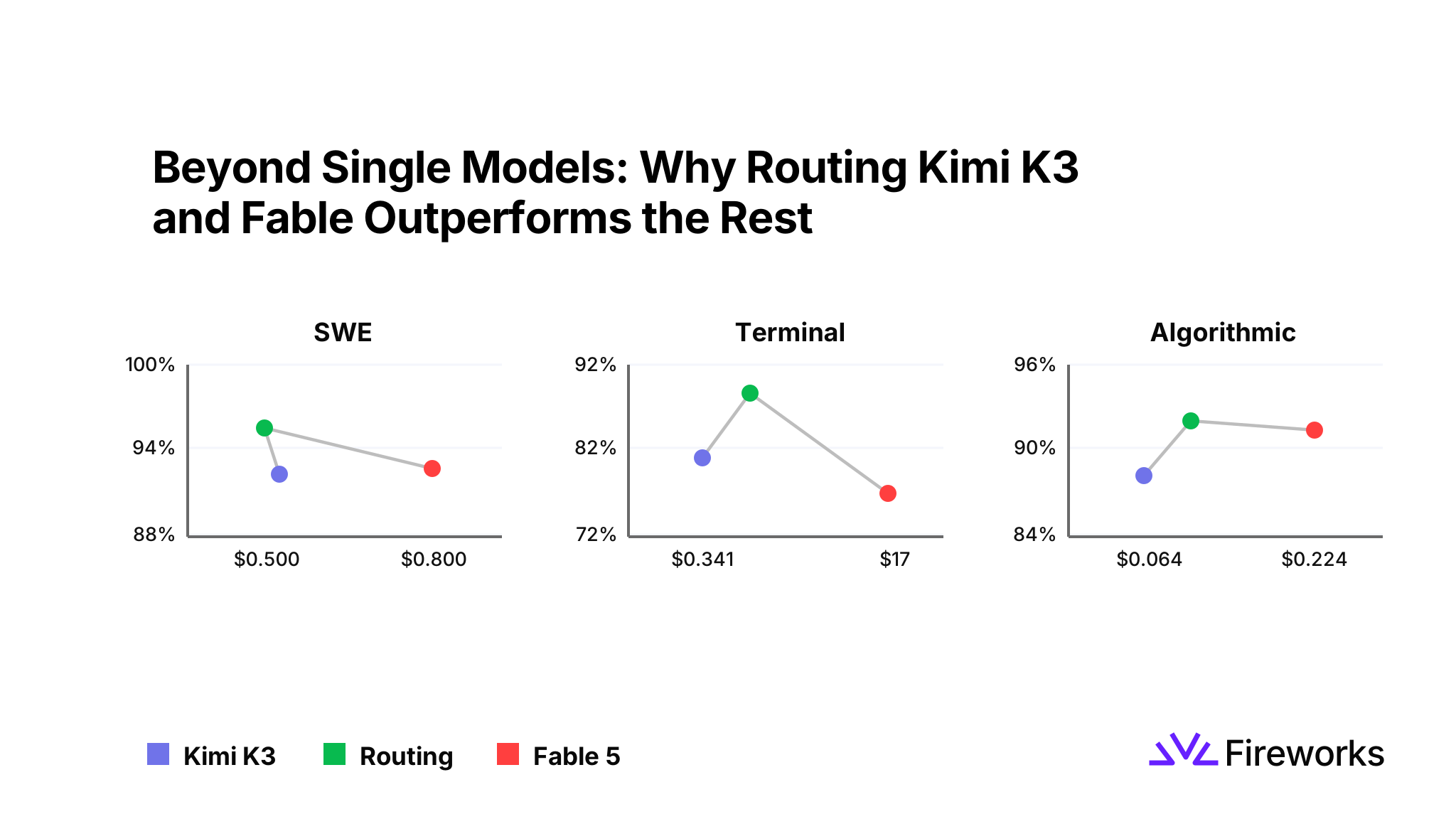
A study by Fireworks.ai shows that the open model Kimi K3 is competitive with the closed Fable 5 while being significantly cheaper. By routing tasks to the most appropriate model, users can achieve 93% accuracy and up to 50x cost savings. This highlights a shift toward using mixtures of specialized models rather than a single provider to achieve the best AI performance.
Key Points
- Kimi K3 is a frontier-quality open model that matches Fable 5's performance at a fraction of the cost.
- Routing tasks between K3 and Fable 5 results in 93% accuracy, outperforming both models individually.
- K3 shows specific dominance in agentic terminal tasks, security, and symbolic math, while Fable excels in coding language breadth.
- K3 can be up to 50x more cost-effective than Fable 5, particularly when leveraging prompt caching on Fireworks.
- The author posits that single-model solutions are becoming obsolete and that the future of AI lies in specialized routing and model mixtures.
Sentiment
The overall sentiment is mixed and skeptical. HN generally accepts that Kimi K3 is an important and promising model and that routing across models is likely to matter, but the community does not broadly accept the article's strongest state-of-the-art framing. The most common stance is cautious interest: Kimi K3 may be cost-effective for some agentic work, but claims about parity with Fable need better methodology, real-world testing, and clearer treatment of latency, token usage, and harness effects.
In Agreement
- Several hands-on users report that Kimi K3 is close enough to frontier closed models for many ordinary coding and web app tasks, making it plausible as a cheaper default in a routed system.
- Commenters agree that different models have different strengths and that routing among specialized models is a sensible direction for agentic AI systems.
- Open-weight or soon-to-be-open-weight models are seen as strategically useful because they reduce dependence on closed labs, sudden model changes, access limits, and provider-specific restrictions.
- Some participants argue that current speed and pricing problems may improve once more inference providers host the model and compete on deployment quality.
- A few commenters accept practical model-plus-harness comparisons as useful because users care about the end-to-end system they can actually run, not only isolated model capability.
Opposed
- Many commenters argue that benchmark performance is unreliable because models can appear strong on public evaluations while still failing or wasting tokens on real-world agent tasks.
- Several users report that Kimi K3 is slow, verbose, token-inefficient, or unable to make progress on more complex coding and debugging work compared with stronger closed models.
- The article's methodology is questioned because testing each model through a different harness can conflate model quality with toolchain prompts, caching behavior, and vendor optimization.
- Oracle routing is criticized as an unrealistic upper bound because production systems do not know ahead of time which model will succeed on a given task.
- Some commenters dispute the 'open model' framing when weights are not yet fully available, and others object that opaque hosted versions may involve unknown quantization or deployment compromises.