The Efficiency Flip: How Chinese Breakthroughs are Powering Western AI
413
Western AI companies are quietly saving their business models by adopting massive efficiency breakthroughs shared by Chinese labs.
The economics and pricing strategies of AI products and services, including subscription vs. usage-based billing, platform monetization, and the financial dynamics of AI infrastructure.
Western AI companies are quietly saving their business models by adopting massive efficiency breakthroughs shared by Chinese labs.
OpenAI has launched a tiered ChatGPT Pro subscription model featuring a new $500 monthly plan with exclusive 'Ultrafast' access and updated usage allowances across the board.

Claude Opus 5.5 is a premium, top-ranked reasoning model that trades higher costs and verbosity for industry-leading intelligence and a 1M token context window.

A comprehensive pricing guide for OpenAI's 2026 API suite, covering GPT-5.6, multimodal generation, and integrated developer tools.

Corporate demand is shifting from expensive 'frontier' AI models to cheaper, efficient alternatives, challenging the high-cost business model of labs like Anthropic.

AI intelligence is rapidly commoditizing with a 100x annual price drop, shifting the bottleneck from model capability to human judgment and system scale.

A high-capacity MoE model with a 1M context window and competitive pricing.

Mark Zuckerberg is positioning Meta as the open-source champion of AI to challenge the dominance of 'closed' rivals and empower individual users.

OpenAI is leveraging AI-driven efficiency gains to slash GPT-5.6 prices and introduce a high-speed API mode for frontier intelligence.

Artificial Analysis provides a data-driven comparison of AI models, ranking them by intelligence, speed, and cost to help users identify the best model for their needs.
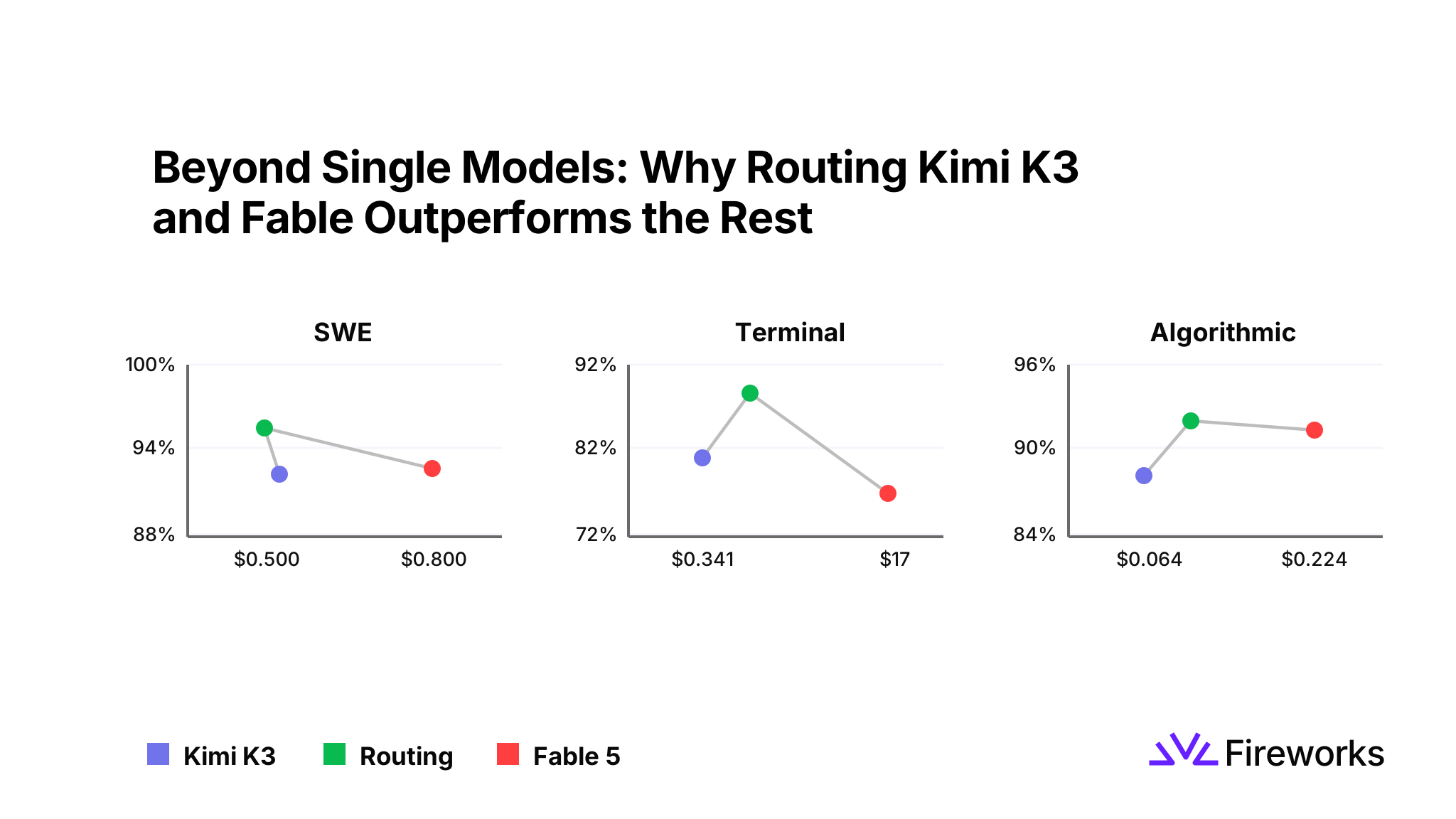
Routing tasks between the open Kimi K3 and closed Fable 5 delivers higher accuracy and massive cost savings compared to using any single frontier model.
OpenAI launches a context-driven, self-service advertising platform for ChatGPT to reach users during high-intent decision-making moments.

China is challenging US AI dominance by releasing open-weights models that commoditize the technology and build a superior global ecosystem.

SaaS remains relevant because businesses prefer paying for the convenience and reliability of a managed service over the hidden costs of maintaining DIY AI-generated tools.
The 'price per million tokens' metric is a misleading illusion because different model tokenizers can quietly inflate your bill by over 70% for the exact same code.
Claude AI extends Fable 5 promotional access for paid users until July 12 with a 50% weekly usage cap.

Websites are diligently fighting a 2023 war against AI training crawlers while remaining strategically blind to the real-time answer bots that define the current AI landscape.

The rise of high-performance open-weights models is set to destroy the high profit margins currently enjoyed by frontier AI labs on inference costs.

Claude Sonnet 5 delivers high-end agentic performance and improved safety at a mid-tier price point.

Open-source AI is a necessary and inevitable shift required to ensure global digital sovereignty and economic sustainability against proprietary monopolies.

Sakana Fugu is an AI orchestration platform that uses collective intelligence from multiple models to outperform individual frontier LLMs on complex tasks.

Anthropic leverages its 'safety' mission as a strategic tool to align its business goals, capture user data, and assert control over the future of AI development.

Anthropic has overtaken OpenAI as the world's most valuable AI startup, reaching a near-$1 trillion valuation on the back of explosive revenue growth and new model releases.

Enterprises are scaling back indiscriminate AI spending in favor of cost-effective, disciplined implementation as the initial hype meets the reality of low ROI.
AI labs have found product-market fit by pivoting to usage-based enterprise pricing for high-token-consumption coding agents.

Elon Musk's lawsuit against OpenAI and Sam Altman failed because a jury determined his claims were filed too late under the statute of limitations.
AI is a massive, capital-heavy platform shift that commoditizes intelligence, shifting the competitive landscape from model development to application-level value and human-led judgment.

OpenAI is launching a $4 billion deployment-focused subsidiary and acquiring Tomoro to help enterprises deeply integrate frontier AI into their core business operations.

GPT-5.5's 2x price increase is mitigated to a 49-92% actual cost rise because the model produces shorter responses for long prompts.

Anthropic is dramatically scaling Claude's availability and performance through a massive new compute deal with SpaceX.
An editorial project documenting the disappearance of 100 AI tools through shutdowns, acquisitions, and domain lapses, primarily occurring in 2026.

Anthropic and leading financial partners are creating a new services firm to provide mid-sized companies with the engineering expertise needed to integrate Claude AI into their operations.

Uber's AI budget was exhausted in four months because its engineers became unexpectedly dependent on high-cost, high-productivity AI coding tools.
Anthropic's Claude Code is reportedly penalizing users for mentioning competitor 'OpenClaw' in their codebases.
OpenAI has built a sophisticated end-to-end advertising system for ChatGPT that uses contextual injection and a dedicated tracking SDK to close the attribution loop.

Microsoft is ending revenue sharing and exclusivity in its partnership with OpenAI to adapt to rapid AI innovation.

StackAdapt and OpenAI are piloting an advertising program to place brand messages inside ChatGPT's user interface.

Claude Opus 4.7's new tokenizer increases token counts for the same data, effectively raising costs despite unchanged per-token pricing.
Upgrading from Opus 4.6 to 4.7 leads to a nearly 40% increase in token usage and API costs.

Rising GPU costs and limited supply have ended the era of abundant AI, forcing the industry into a multi-year period of gated access and strategic resource management.

Anthropic defended a shift from 1-hour to 5-minute cache TTL in Claude Code as a cost-saving measure, despite user claims that it increased expenses for high-context sessions.
OpenAI is bringing ads to ChatGPT's free tiers in the US, offering a choice between ad-supported access and a limited ad-free experience.

Switch from fixed AI subscriptions to usage-based credits using Zed and OpenRouter to maximize flexibility and stop wasting money on non-rolling limits.

ChatGPT provides a multi-tiered pricing structure that scales AI capabilities and security features from free individual use to high-end enterprise requirements.

Sam Altman has transformed OpenAI from a safety-first nonprofit into a profit-driven geopolitical powerhouse by leveraging a 'reality-distortion field' and a relentless will to power.

Investors are abandoning OpenAI for Anthropic on secondary markets, driven by a preference for Anthropic's enterprise-led growth and better risk-reward profile.
OpenAI is transitioning Codex from per-message pricing to a token-based credit system to better align costs with actual model usage.

Anthropic's Claude Code is facing backlash as a mix of policy changes and technical bugs causes users to hit usage limits prematurely, stalling developer workflows.

The AI investment bubble is reaching a breaking point where unsustainable costs and competitive outspending will likely trigger a systemic financial crash.

Paperclip is an open-source orchestration engine that manages multiple AI agents as a cohesive, autonomous company with built-in governance and budget controls.

AI agents are replacing specialized SaaS tools as the primary interface for product development, forcing traditional software companies to choose between reinvention and commoditization.
A developer created a custom RAG-powered AI voice agent to handle service inquiries and capture leads for a mechanic shop.

OpenAI is pivoting from experimental innovation to a disciplined enterprise strategy to win a high-stakes IPO race against Anthropic and SpaceX.

Anthropic is investing $100 million in a new partner network to provide the training, certification, and technical support required for enterprise-wide Claude adoption.

Claude is doubling usage limits during off-peak hours for most plan types from March 13 to March 27, 2026.

Elon Musk is purging xAI's leadership and using Tesla and SpaceX resources to salvage the startup's failing AI products ahead of a massive planned IPO.

Atlassian is laying off 10 percent of its staff to fund a strategic shift toward AI amid a massive stock decline and industry-wide disruption.

Prism is an all-in-one AI video generation platform that aggregates top-tier models to help creators and businesses build professional, commercial-ready content from text prompts.

The reported $5,000 loss per Claude Code user is based on retail markups rather than actual compute costs, masking the fact that Anthropic's inference is likely profitable.

In an era of commoditized AI intelligence, the true competitive advantage and value lie in the context and connections that enable agents to function.

The author argues that OpenAI's recent government deal was a corrupt 'scam' enabled by political donations, marking a shift from capitalism to oligarchy.

This article details the legal, compliance, and security requirements for Claude Code, focusing on licensing terms and strict authentication protocols.

Claude will stay ad-free so it remains a trusted, user-aligned tool for thought, funded by subscriptions and enterprise—not advertising.

AI turns specs into commodities, so the real business value has shifted from code and components to running, securing, and scaling software operations.

Tailwind closed a PR for LLM-friendly docs to prioritize business survival after AI-driven traffic and revenue declines, with a willingness to revisit when sustainable.

Apple’s restraint on AI spending makes it a defensive winner as AI exuberance cools, but the stock now looks pricey and stretched.
AI’s hype disguises a power shift: from productivity promises to private control over land, energy, and water via datacenter infrastructure.

Sora marks OpenAI’s pivot from world-changing promises to ad-fueled AI slop, revealing tempered faith in near-term transformative power.

Use an agent-specific MSA to align legal risk, data rights, and pricing with autonomous AI behavior so you can monetize agents safely and effectively.

In today’s AI-fueled red ocean, differentiation dies fast—only distribution and deep moats endure.
LLMs dazzle in demos but aren’t essential in real work, risking renewals and the AI industry’s massive GPU bets.

Zed switches to token-based AI billing, cuts Pro to $10 with credits, adds top models, and offers flexible BYO/local options with a staged migration.

As AI answer engines disrupt traffic-based monetization, Cloudflare champions a new model where AI companies pay creators for the unique content that improves their models.

Faster LLMs will reshape coding workflows and productivity, but escalating demand, hardware limits, and pricing pressures mean a bumpy, fast-changing road ahead.
AI will unlock unstructured data, augment work, and reward fast-moving startups that build AI-native, consumption-priced products now.