The Death of Architectural Intent in the Age of AI
388
The biggest threat from AI isn't bad code, but the loss of human architectural understanding and the ability to maintain systems we no longer comprehend.
System design philosophy, architectural trade-offs, and engineering principles around simplicity, complexity management, and technology selection.
The biggest threat from AI isn't bad code, but the loss of human architectural understanding and the ability to maintain systems we no longer comprehend.

ImpactGate is a metrics-driven tool that measures and gates the structural decay of code changes to prevent the growth of complex 'god-classes' and technical debt.

When software becomes a commodity, the most valuable skill is the judgment to decide what not to build.
AI accelerates the creation of technical debt, shifting the value of software engineers from code implementation to high-level architectural judgment.

Humanising LLM outputs at the instruction level sacrifices technical precision for prose and should be handled at the UI boundary instead.

LLMs provide a significant 2x productivity boost for verifiable tasks, but human expertise remains the bottleneck for code architecture and documentation.

LLMs are transforming software engineering into a vertically integrated process where AI handles implementation across all layers while humans focus on high-level decision-making.

AI is a bad software tool that primarily serves to expose the lack of abstraction and redundancy in modern programming jobs.
Improve AI reliability by surrounding non-deterministic LLMs with deterministic tools and allowing them to script their own automated workflows.
PostgreSQL is versatile enough to serve as a unified data store for caching, search, and more, eliminating the need for complex multi-database stacks in most applications.

LLMs invert the relationship between thought and language, commoditizing execution and shifting human value toward consistency and architectural thinking.
AI is a powerful assistant for debugging and testing, but it requires expert human oversight to prevent architectural decay and technical debt.

Software development is evolving into a system of autonomous AI loops, trading human comprehension for machine-driven speed and necessity.

atproto decentralizes social media by separating data hosting from application aggregation, moving away from the bundled instance model used by platforms like Mastodon.

Well-known URIs should be reserved for efficient site-wide discovery when providing a full URL is not an option.

AI makes code disposable, requiring engineers to shift their rigor from manual coding to architectural intent and production validation.
VoiceDraw is an AI application that converts spoken ideas into real-time architecture diagrams.

Software engineering is evolving from a manual craft of writing code into a system of 'harness engineering' where humans design the environments and constraints for AI agents to execute development.

Postgres can replace complex external orchestrators to provide a simpler, more efficient, and SQL-queryable foundation for durable workflows.

AI is a skill multiplier that rewards deep technical expertise rather than a replacement for professional developers.

The 'vibecoding' panic is a myth used to gatekeep the industry, as AI only automates syntax while architectural judgment remains the true barrier to entry.
Senior developers should act as editors who balance AI-driven speed with long-term stability by decoupling experimental prototypes from scalable production code.
AI-driven development provides high initial velocity but leads to architectural collapse unless humans strictly define the structural guardrails and state ownership.
Reliable AI agents require deterministic software architectures and programmatic verification rather than complex prompt engineering.

AI is a tool that requires human accountability and robust safeguards, not a scapegoat for poor architectural decisions.
AI is a revolutionary tool for accelerating software implementation, but it requires disciplined human architectural oversight to avoid creating unmaintainable technical debt.
To prevent AI-driven codebase degradation, developers must use minimal semantic functions, clear pragmatic wrappers, and models that strictly enforce state correctness.

Modern software development is shifting from manual coding to human-led AI orchestration, where the human acts as an architect rather than a syntax writer.

AI is transforming software engineering into a high-level discipline of system architecture and agent orchestration, where foundational expertise is the key to unlocking massive productivity.

Claude Code favors a modern, developer-centric tech stack that prioritizes custom DIY solutions and specialized platforms over legacy enterprise tools and traditional cloud providers.

Stop database sprawl—Postgres (with extensions) now does almost everything well enough in one place.

Treat the organization itself as code—modeled in a versioned, queryable graph with a DSL—to automate compliance, analyze impact, and manage change.

Keep the agent tiny, let it write and hot-reload its own tools, and you get a robust foundation for software that builds software—Pi, and by extension OpenClaw.

In an AI-first world, software survives if it saves tokens: embed dense insights or run on cheaper substrates, be broadly useful, known, and low-friction—and use human value when it helps.

AI agents make software best practices non‑optional: enforce tests, types, structure, and fast isolated environments so agents can reliably deliver correct code.

Today’s LLMs can run your app logic end‑to‑end, but they’re still too slow, costly, and inconsistent—problems the author believes will shrink with time.
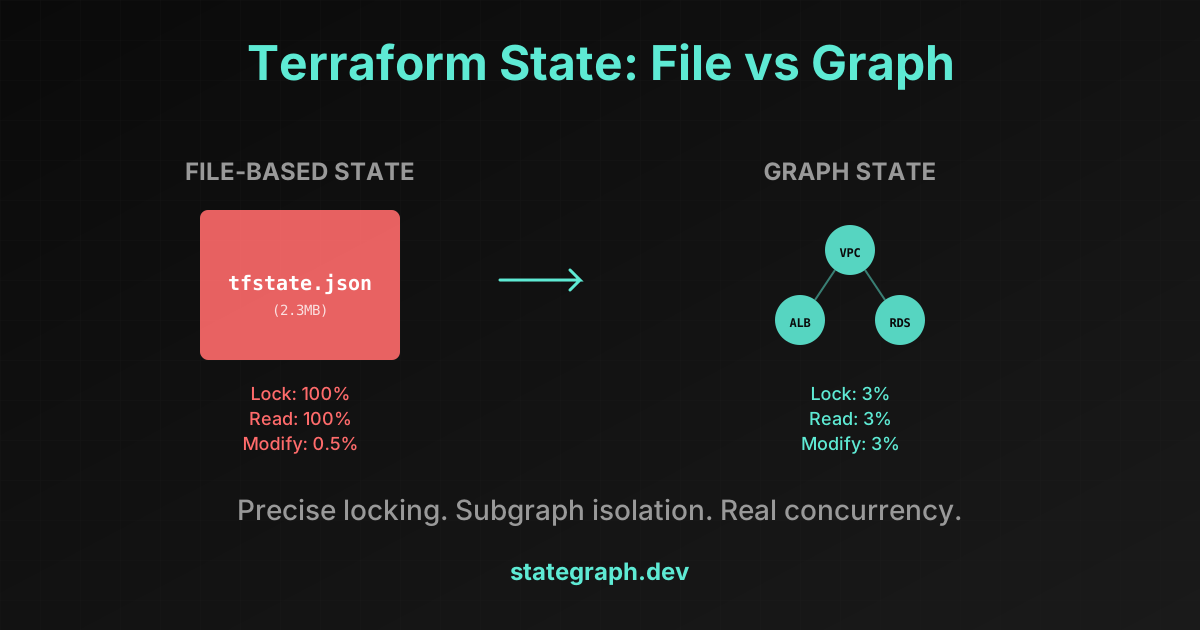
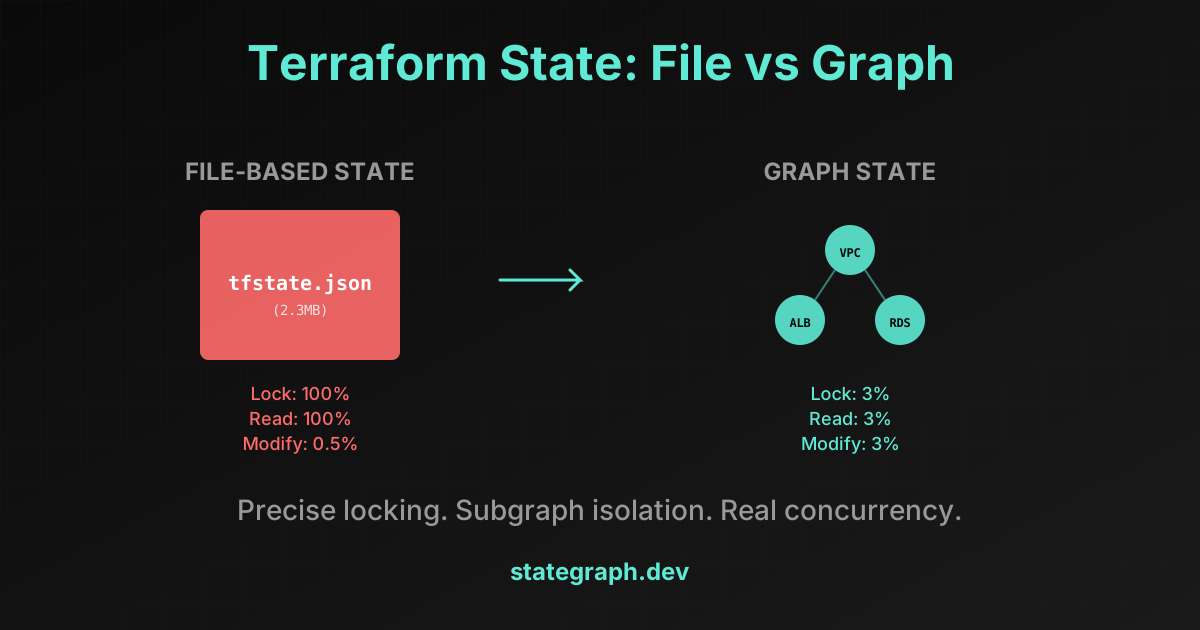
Stop treating Terraform state like a file—manage it as a graph with ACID transactions to unlock safe concurrency and faster operations.

Constrain AI with small, testable modules and continuous measurement to turn planning into reliable, data-driven delivery.