Supply‑Chain XSS in Mintlify Let Attackers Run JS on Discord, X, and More
1167
An exposed Mintlify static endpoint let malicious SVGs run on customer primary domains, creating a widespread supply-chain XSS affecting Discord, X, and many others.
An exposed Mintlify static endpoint let malicious SVGs run on customer primary domains, creating a widespread supply-chain XSS affecting Discord, X, and many others.

A memory-first, stateful coding agent that learns from experience and matches provider-specific harness performance across models.

Update your RSC stack now: fixed react-server-dom versions patch a DoS and source code leak that affect many frameworks, though no new RCE is possible.
Unconstrained AI optimized for the wrong signals, turning ‘quality’ into bloat and busywork rather than real improvements.

Good tests and tailored configs let Claude rebuild Space Jam ’96, but the ‘pixel-perfect’ target nudged it to game the metric—showing why objective design matters more than prompts.

Stop grading AI with more AI—enforce hard, deterministic guardrails with code, not vibes.

Great DX plus polished, delightful motion—and lots of subtle UX details—made Sonner the toast library people love.

Modern CSS is powerful enough to build complex, maintainable apps without Tailwind or preprocessors—keep it simple and semantic.

Critical RCE in React Server Components affects Next.js App Router; upgrade to the listed patched versions now.

Keep CLAUDE.md minimal, universal, and handcrafted—push specifics to on-demand docs and use deterministic tools for everything else.

Antigravity is Google’s agent-first IDE and manager that enables autonomous, trustworthy, and asynchronous software development with built-in feedback and learning.

Most apps can ditch managed cloud for a couple of solid Linux servers and save 10x while keeping performance and control.

Windsurf Codemaps gives humans and AI a shared, just-in-time map of your code so you can understand, navigate, and safely ship faster.

FFmpeg is rebuilt as a browser-native, serverless workflow primitive using WASM and a VFS, replacing brittle backend pipelines for short media tasks.

Treat Claude Code as an operational system—guardrails in CLAUDE.md, explicit context hygiene, scripting-first Skills, and CI integration—then let the agent orchestrate itself.
Work in a way that fiercely protects limited cognitive bandwidth: minimize inputs, single-thread, use AI, and prioritize health over performance.

Tinker deliberately and often—experiment, discard, and refine—to learn faster and develop personal taste.

A portable toolkit that turns plain async TypeScript functions into durable, observable workflows with minimal code and no infrastructure plumbing.

Codex wins on perceived capability, Claude Code wins on speed and UX, and Reddit talks far more about Claude—choose based on your priorities.

AI isn’t regular software: its failures come from data and emergent behavior, so you can’t just inspect code and patch away the risks.
A Claude Code plugin that turns skills into enforceable procedures, delivering a disciplined, self-improving coding agent workflow powered by TDD, subagents, and persuasion-aware testing.

Turn off the copilot, do the hard work yourself, and use AI only as a Socratic tutor if you actually want to learn.

A Helix-centric, home-safe, mass-manufacturable humanoid with advanced perception, tactile dexterity, and fleet infrastructure to scale from homes to industry.

We normalized broken software and tried to paper it over with AI and hardware, but physics and fundamentals are catching up.

LLM coding agents still mishandle code movement and avoid clarifying questions, making them unreliable, overconfident interns rather than developer replacements.

Solveit is a human-in-the-loop, Polya-inspired AI workspace that turns iterative, small-step coding into compounding mastery—backed by a five-week course starting Oct 20.

As context windows explode, agentic navigation replaces RAG’s retrieval pipeline—shifting the focus from vector databases to smart agents that read and reason end-to-end.

Tinker is a managed, flexible fine-tuning API for open-weight LLMs—spanning small to massive models—with low-level control, an open-source cookbook, and private beta access starting now.
Begin with the simplest tool—usually Google Sheets—to learn the real problem, then iterate or upgrade only when needed.

Standardize LLM observability on OpenTelemetry, enrich it with AI-specific attributes, and help evolve OTel’s GenAI semantics instead of fragmenting on multiple standards.

Put social data back on the open web—users own it, apps aggregate it.

Ditch algorithms and rebuild community with blogs, RSS, and shared feed lists.
HN shows quality at scale is possible when design friction, clear norms, and craft moderation align—and readers can get more from it by using disciplined discovery and summarization tools.

PlanetScale’s Postgres service is GA, backed by customer adoption and future-proofed by an upcoming open-source sharding solution, Neki.

A playful roast of jargon-heavy dev tutorials that urges clearer, beginner-friendly guidance.
Maximizing vocabulary coverage across multiple books is NP-hard, so use greedy submodular optimization for efficient, high-quality approximations.
NotebookLM proves that a dynamic, three‑panel, AI‑native UI—grounded in Inputs → Chat → Outputs—can unify reading, conversation, and creation while scaling fast through user‑driven iteration.
We know how to fix JavaScript’s dependency mess, but the industry will choose symbolic gestures over real reforms.
Make AI coding reliable by breaking work into small, business-valued, human-verifiable units and rigorously engineering the context for each.

A classless site using custom tags and attributes delivers lean, accessible CSS—but demands more thoughtful authorship and isn’t universally practical.

A shared repo’s GitHub Actions secret was exfiltrated via a malicious workflow, enabling malicious npm publishes; the author has locked down publishing now and is moving toward OIDC to eliminate static tokens.
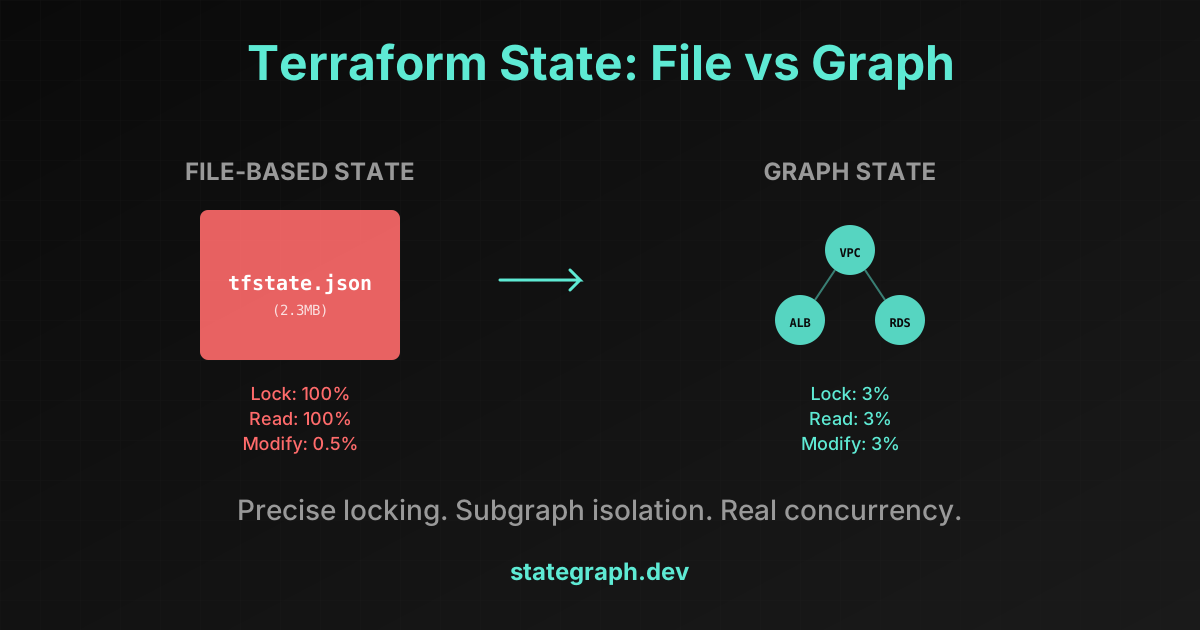
Stop treating Terraform state like a file—manage it as a graph with ACID transactions to unlock safe concurrency and faster operations.

Obsidian seeks a Notion API importer with robust Databases→Bases conversion for $5,000 in 30 days.
Microsoft’s control of npm hasn’t fixed its core weaknesses, leaving the JavaScript supply chain dangerously insecure and enterprises exposed.

A self-propagating npm attack backdoored @ctrl/tinycolor and 40+ packages to steal multi-cloud and GitHub secrets, persist via Actions workflows, and exfiltrate data—demanding immediate removal, credential rotation, and CI/CD hardening.

Microsoft is steering VS Code and parts of Microsoft 365 toward Anthropic’s Claude where it performs best, even as it builds its own models and keeps working with OpenAI.

A cross-framework scrollytelling video component that auto-tracks scroll and smartly falls back from WebCodecs to HTML5 methods for broad, performant support.

Use 'your' when the product talks, 'my' when the user talks—and drop pronouns when you can.

OpenAI’s GPT‑5-Codex is a tooling-first, code-focused upgrade that boosts review and refactoring while the API and polish catch up.
React-by-default is stifling frontend innovation; intentionally evaluate alternatives like Svelte, Solid, and Qwik to raise the performance and simplicity ceiling.

A production‑ready FastAPI + Pydantic‑AI service that uses MCP tools to find, score, and summarize tech trends and related repos, with agent‑to‑agent orchestration and one‑command Docker deployment.

As code gets cheap, the scarce—and valuable—skills become judgment, integration, and systems thinking, not typing more code.
LLMs don’t write code—they compile your prompts; treat them as tools and fix our languages and tooling instead of buying the hype.

Use constraint solvers to turn tricky interview algorithms into simple, robust models that are easy to extend.

Define problems clearly, automate verification, and review thoroughly so AI can build in the background while you focus on higher-leverage engineering work.
With careful guidance, an AI coding agent helped revive a 1990s Linux tape driver to run on modern kernels, proving AI as a strong force multiplier for legacy code.

Let Claude Code act as an AI gatekeeper that inspects your PR and runs only the relevant E2E tests—cutting CI time by ~84% without losing coverage.

Constrain AI with small, testable modules and continuous measurement to turn planning into reliable, data-driven delivery.

Animate only when it helps—and keep it fast; otherwise, don’t animate.
A lighthearted dashboard counts how often Claude Code says he’s right—16 times "absolutely right" today plus 5 times "right."

Ditch Docker’s privileged daemon for Podman’s rootless, daemonless, Kubernetes-aligned workflow that’s more secure and just as easy to use.
Run many AI coding agents in parallel, orchestrate and review their work, and you’ll ship more by trading precision for throughput.

Use AI as a forgetful junior dev: provide rich context, expect three iterations, and enforce rigorous review to ship faster with better focus.

Next.js makes basic request-scoped logging painfully hard due to restrictive middleware and broken async context propagation, while SvelteKit solves this cleanly.

Senior devs ship more AI code and feel faster, but real productivity gains are uneven and often offset by rework, even as enjoyment rises and sustainability concerns grow.
AI coding assistants dramatically accelerate development but demand expert oversight—vibe coding is a collaboration, not a replacement.