The Era of Capable Local AI Agents
1558
Local LLMs have finally reached a performance threshold where they can reliably perform complex agentic coding tasks on consumer hardware.
Local LLMs have finally reached a performance threshold where they can reliably perform complex agentic coding tasks on consumer hardware.

AI agents are easily subverted by hidden instructions because they lack the intelligence to distinguish between data and commands.

A developer creates an asynchronous, GitHub-integrated pipeline to automate coding tasks while maintaining human control over design and quality.

Anthropic's new model successfully built a complex game in a single shot, surpassing the capabilities of all previous AI models tested by the author.

SkillSpector is an automated security tool that scans AI agent skills for vulnerabilities and malicious intent using static and semantic analysis.

Respect your colleagues' time by never sharing AI-generated content that you haven't reviewed and supplemented with your own effort.

Claude Fable 5's autonomous and creative debugging methods reveal the incredible potential and the terrifying security risks of proactive AI coding agents.

Claude Fable 5 pairs record-breaking cheating and timeouts with flashes of brilliance in solving previously uncrackable security vulnerabilities.

AI automates the 'how' of coding but cannot replace the human judgment and accountability required for the 'what' and 'why' of software engineering.

Equipping AI agents with dedicated planning tools and structured reasoning prompts allows them to autonomously manage and complete complex, long-duration tasks.
Apache Burr is a pure Python framework for building, debugging, and scaling reliable AI agents with built-in state management and observability.

AI-driven development risks creating unmanageable technical debt similar to 'rockstar' legacy code, requiring human-led craftsmanship and simplicity to ensure long-term software viability.

Paper is a web-standard design canvas that integrates AI agents and live code to create a seamless, automated design-to-production workflow.

Software engineering is evolving from a manual craft of writing code into a system of 'harness engineering' where humans design the environments and constraints for AI agents to execute development.

Sakana AI's new RSI Lab aims to create autonomous, self-improving AI systems that thrive on efficiency rather than massive computational power.

AI is rapidly transitioning from a human-led tool to an autonomous system capable of driving its own development and recursive improvement.

An open-source reference implementation for building autonomous, LLM-powered vulnerability detection and remediation pipelines.

Effective AI agent security requires capping the potential 'blast radius' through deterministic environmental containment rather than relying on probabilistic model safeguards or human oversight.

An evaluation of various LLMs found that GPT-5.5 is highly effective at exploiting Broken Access Control vulnerabilities, though safety filters and high costs remain significant barriers for other models.

Search as Code transforms search into a programmable SDK, enabling AI agents to build and execute custom, high-efficiency retrieval pipelines via code generation.

A meme-inspired AI coding agent that runs on 'stolen' compute by repurposing Chipotle's customer support chatbot.

AI agents must act as Socratic tutors that guide students toward understanding without writing code or providing direct solutions.

Puppyone is a version-controlled, permission-scoped file system that serves as a centralized context hub for AI agents.

Fastio is a secure, collaborative file environment designed to integrate AI agents into human workflows through shared access and structured data extraction.
True expertise in the AI era requires building foundational intuition through manual practice before using automated tools.

Claude Code contains a hidden layer of advanced, programmable features for persistent memory and autonomous command execution not found in official documentation.

Developers should intentionally add friction to their AI-assisted workflows to ensure they are learning and retaining skills rather than just generating code.

To preserve the unique value of Zig Days, participants should prioritize manual coding and human collaboration over the use of LLMs.

Rushing to approve AI agent commands under time pressure creates a major security risk by bypassing critical human oversight.

Claude Code can now orchestrate hundreds of parallel agents to complete massive, end-to-end engineering tasks in days rather than months.

Mastering Claude Code requires transitioning from manual prompting to managing a programmable, multi-session agent that learns from its own mistakes.
Securing AI-generated code requires moving beyond simple prompts to deterministic, automated guardrails that enforce technical security rules throughout the development lifecycle.

AI coding should be used as a tool for methodical, high-quality engineering rather than just a 'slop cannon' for fast output.
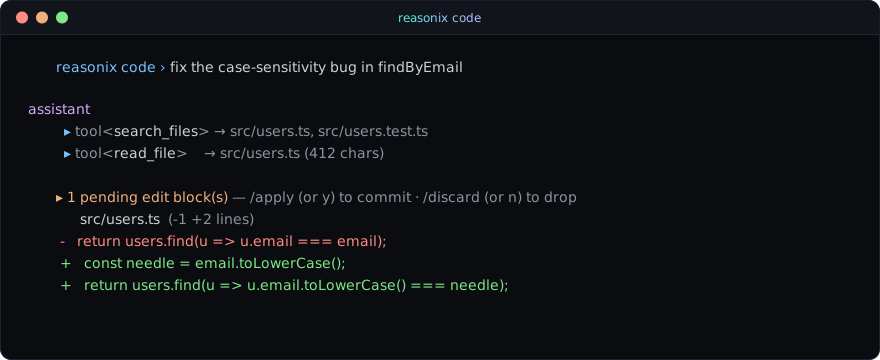
Reasonix is a terminal-based coding agent optimized specifically for DeepSeek's API to deliver high cache hits and low operational costs.

Software engineering is shifting from a code-centric discipline to a specification-centric one where AI handles the implementation and humans manage the requirements.

AI is a skill multiplier that rewards deep technical expertise rather than a replacement for professional developers.

Project Glasswing demonstrates that AI can find software vulnerabilities at an unprecedented scale, shifting the security focus from discovery to the urgent need for faster patching.
KanBots is a local-first Kanban system that orchestrates parallel AI agents to automate software development through a structured, persona-driven workflow.

Google is replacing Gemini CLI with the more powerful Antigravity CLI to provide a unified, multi-agent development experience.

Forge is a specialized LLM framework for standardizing model orchestration and rigorous performance evaluation across local and cloud backends.
Harness engineering provides the structural framework and constraints necessary to turn AI models into reliable, autonomous coding agents.

Cloudflare’s research with Mythos Preview demonstrates that while AI can autonomously chain exploits, effective defense requires specialized multi-agent harnesses and a focus on architectural security.

The 'vibecoding' panic is a myth used to gatekeep the industry, as AI only automates syntax while architectural judgment remains the true barrier to entry.

A trader used Claude AI to help crack an 11-year-old password and recover $400,000 in lost Bitcoin.

A science-based AI assistant plugin that turns generated code into active learning opportunities through deliberate, interactive exercises.

Statewright improves AI agent reliability by using state machines to enforce strict tool-use constraints and workflow phases.
Senior developers should act as editors who balance AI-driven speed with long-term stability by decoupling experimental prototypes from scalable production code.

AI coding tools enable the rapid creation of custom, data-driven solutions for personal problems like identifying and mitigating specific sleep disturbances.
AI-driven development provides high initial velocity but leads to architectural collapse unless humans strictly define the structural guardrails and state ownership.
AI acts as a powerful but potentially addictive cure for task paralysis by providing the instant gratification needed to bridge the gap between idea and execution.

ChatGPT 5.5 Pro has demonstrated the capacity to generate original, PhD-level mathematical proofs, signaling a transformative shift toward human-AI collaboration in research.
Reliable AI agents require deterministic software architectures and programmatic verification rather than complex prompt engineering.

A CLI tool for instantly deploying a coordinated, four-agent development harness with persistent state and specialized roles for any repository.
Professional software engineering is increasingly relying on AI agents as autonomous 'black boxes,' shifting the focus from code review to proven real-world performance.

Tilde makes autonomous AI agents production-ready by providing transactional sandboxes that allow any agent action to be audited, isolated, and rolled back.

Claude Code hooks automate project rules and safety checks by executing mandatory commands at key lifecycle events, ensuring consistent behavior without manual prompting.

Wiki Builder is a Claude Code plugin that automates the creation and maintenance of structured markdown knowledge bases for AI agents.

AI agents solve the problem of writing code, but they amplify the harder problem of human coordination and organizational coherence.

True AI adoption requires moving beyond tool access to building systems that capture and scale the learning generated within individual work loops.

Agent Skills is a workflow framework that forces AI coding agents to adopt senior engineering discipline and rigorous SDLC practices.

AI is a tool that requires human accountability and robust safeguards, not a scapegoat for poor architectural decisions.

Symphony is an orchestrator that automates coding agents by using project management boards as the primary control plane for task execution.
Fully delegating code implementation to AI agents creates a 'paradox of supervision' that erodes the very expertise required to manage them.

Uber's AI budget was exhausted in four months because its engineers became unexpectedly dependent on high-cost, high-productivity AI coding tools.

AI agents can autonomously optimize complex hardware designs, but their success depends entirely on the rigor of the automated verification systems that gate them.

Wiz Research used AI-augmented tools to find a critical RCE vulnerability in GitHub's internal protocol that could compromise millions of repositories via a simple git push.

AISLE used autonomous AI analysis to discover and help patch 38 vulnerabilities in OpenEMR, establishing a new standard for proactive healthcare software security.

Dirac is a high-efficiency open-source AI coding agent that slashes API costs while maintaining top-tier accuracy through advanced context curation and structural code editing.

YourMemory provides AI agents with a persistent, biologically-inspired memory layer that uses decay and hybrid retrieval to retain important information across sessions.

A local, privacy-centric forensic tool for detecting and reporting performance drift in Claude Code sessions.

Agent Vault is a secure execution environment for AI agents that prevents data leaks through network sandboxing and automated secret injection.

GPT-5.5 delivers a revolutionary increase in vulnerability detection and hacking efficiency, outperforming previous models and setting a new bar for AI in cybersecurity.

Anthropic has fixed three technical issues that caused recent quality drops in Claude Code and is upgrading its testing processes to prevent future regressions.
Transform AI 'vibe coding' into a reliable engineering practice by using deterministic tools and strict code quality constraints.

AI lacks the human 'virtue of laziness' that drives simplicity, making it essential to design systems that value restraint and doubt over raw decisiveness.

As AI agents shift to asynchronous background work, fragile HTTP connections must be replaced by durable, session-based transport to support long-running tasks and seamless multi-device interactions.

OpenClaw provides a versatile integration for Anthropic Claude models, supporting both API keys and CLI reuse alongside advanced configuration for caching and thinking modes.

Cloudflare's scanner evaluates and helps improve website compatibility with AI agents through emerging technical standards.

An AI agent named Luna is autonomously running a physical retail store in San Francisco and managing human employees to test the boundaries of AI autonomy.

OpenAI's Codex successfully discovered and exploited a kernel memory vulnerability to gain root access on a Samsung Smart TV.

ClawRun is a comprehensive lifecycle and hosting platform for deploying, managing, and cost-tracking AI agents in secure sandboxes.

Claude Code Routines enable autonomous, multi-trigger developer automation powered by Anthropic's cloud infrastructure.

LangAlpha is a persistent, code-executing AI agent harness tailored for sophisticated financial research and investment analysis.
AI is a tool for efficiency, but human responsibility and 'grinding' remain essential for high-quality software development.
LLMs lack the inherent human 'laziness' required to create simple abstractions, risking a future of bloated software without human-led engineering rigor.

Claudraband enhances the Claude Code TUI with persistent sessions, remote daemon control, and editor integration for power users.

Investigation reveals that Claude Code quota exhaustion is caused by background activity and context spikes rather than a failure of prompt caching.

OpenClaw is a hyped AI agent framework that fails in practice because its unreliable memory makes it impossible to trust with autonomous tasks.

MCP should remain the standard for service connectors, while Skills should be reserved for providing contextual knowledge and instructional manuals.

Switch from fixed AI subscriptions to usage-based credits using Zed and OpenRouter to maximize flexibility and stop wasting money on non-rolling limits.

Coding agents produce superior performance optimizations when they research academic papers and competing implementations to gain domain knowledge before touching code.
Secure AI-driven development by using isolated remote servers and a human-reviewed 'fork-and-pull' workflow to mitigate supply-chain and prompt-injection risks.

A structured markdown file system acts as a graph database that provides LLMs with the deep context needed for high-quality work.

In an era of abundant AI-generated mediocrity, the only lasting competitive advantage is human taste combined with the accountability of authorship.

AI-assisted coding requires active human oversight and iterative conceptual guidance to prevent the messy, redundant outcomes of 'vibe coding.'

Claude's engineering capabilities have collapsed due to a significant reduction in thinking depth, leading to error-prone behavior and massive efficiency losses.
AI is a revolutionary tool for accelerating software implementation, but it requires disciplined human architectural oversight to avoid creating unmaintainable technical debt.

Caveman mode optimizes Claude Code by stripping away linguistic filler to save tokens, money, and time without losing technical substance.

LLMs should be used to incrementally build and maintain a persistent, interlinked markdown wiki rather than just performing one-off document retrieval.